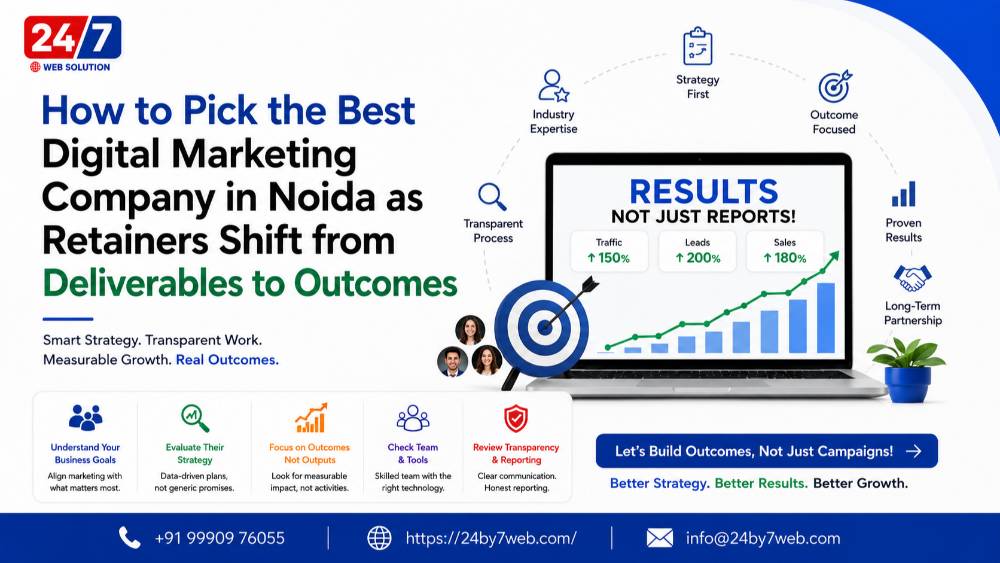
Quick Answer
The best way to evaluate a digital marketing company in Noida is to compare measurable business outcomes, reporting transparency, account ownership, relevant experience, and commercial terms — not simply the number of services an agency offers.
An outcome-oriented digital marketing retainer is an agency agreement in which the scope, KPIs, reporting, and sometimes part of the fee are connected to agreed business objectives rather than only the volume of work delivered. Global agency remuneration is shifting toward a mix of fixed-fee, output-based, value-based, and performance-linked models, according to 2026 World Federation of Advertisers research.
Before Hiring an Agency, Verify These Five Things
- Relevant results you can independently check
- Transparent reporting tied to business outcomes
- Business-owned advertising and analytics accounts
- Clear separation between agency fees and media spend
- Written KPIs, reporting terms, and exit process
Introduction
Traditional labour-based agency remuneration is changing, with brands increasingly using fixed-fee, output-based, value-based, and performance-linked models.
The shift is measurable. A September 2026 World Federation of Advertisers study of 69 multinational companies found that labour-based agency remuneration had fallen from 54% in 2011 to 19%, while fixed-fee/output models increased from 20% to 33% and labour-plus-performance models from 9% to 21%. The research also found that performance-based remuneration remains a relatively small share of total agency fees across most disciplines.
That research covers multinational companies rather than Noida agencies specifically. For anyone searching for a digital marketing company in Noida, the practical lesson is to evaluate how an agency defines, measures, and reports value rather than assuming that a particular pricing model guarantees better results.
This guide is built for business owners, marketing managers, and decision-makers who want a partner whose work connects to business goals, not just activity metrics.
Why Agency Retainers Are Changing
Three forces are driving this change.
First, marketing teams are under greater pressure to show how spending contributes to qualified leads, pipeline, customer acquisition, and revenue. Reporting that stops at impressions and reach is no longer enough for most decision-makers.
Second, data and attribution tools have improved. Google Analytics data-driven attribution uses account data to distribute credit for key events across contributing touchpoints. When measurement improves, paying for activity alone becomes harder to justify.
Third, agencies face pressure from in-house teams, technology platforms, and other providers that increasingly offer strategy, execution, or measurement capabilities. This raises the bar for demonstrating business value rather than simply reporting activity.
The practical implication for anyone looking for a digital marketing company in Noida is straightforward: the questions you ask during selection must change. You are no longer just hiring someone to complete tasks. You are hiring a partner who can explain how their work contributes to business value.
Deliverables vs Outcomes: What's the Difference?
An output-focused agency says: "We published 20 posts this month." "We ran 4 new ad campaigns." "Your engagement rate is up 12%."
An outcome-oriented engagement says: "Three of your last five clients came from LinkedIn content." "Your customer acquisition cost dropped 22% this quarter." "This campaign generated qualified pipeline."
Deliverables still matter. The issue is whether the deliverables are connected to a measurable objective and whether the agency can explain what changed as a result. The number of posts published is an activity metric. For most businesses, the more useful question is whether those activities generated qualified leads, sales opportunities, or revenue.
When you evaluate a digital marketing company in Noida, pay attention to which category they naturally fall into. Ask them to describe a recent client success. If the answer focuses on what they did rather than what changed for the client's business, that tells you something important.
How to Evaluate a Digital Marketing Company in Noida: A Practical Checklist
1. Verify the Track Record
Every agency shows case studies. Very few show ones you can independently check.
Ask for the live website of a client they helped and look at it yourself. Ask which specific metric improved, over what period, and from what starting point. "Traffic up 300%" means very little if it went from ten visitors to forty.
Ask whether the agency can provide a reference or another independently verifiable example. If client confidentiality prevents a reference call, ask for anonymised evidence, documented results, or a live public example instead.
2. Review the Reporting Before You Sign
Ask to see a real sample report, with client details removed. What you want to see is leads, calls, enquiries, cost per lead, and revenue where it can be tracked.
What should give you pause is a report full of impressions, likes, and follower numbers with no connection to the campaign objective. Good reporting transparency is not a nice extra. It is how you find out early whether your money is working.
3. Confirm Account Ownership in Writing
Every ad account, analytics property, tag manager container, and social page should be created in your business's name with you as the owner and the agency as a managed user. Confirm this in the contract, not on a call.
Losing access to account history, conversion data, audiences, tracking configurations, or campaign assets can make an agency transition more difficult and may reduce the continuity of optimisation.
4. Separate Agency Fees from Ad Spend
Where practical, keep advertising accounts and billing ownership under the business's control, and make the agency's management fee separately identifiable from media spend. Bundled "all-inclusive" pricing makes it impossible to know what you are paying for management versus what is actually reaching the platform.
5. Check Relevant Experience
A long list of digital marketing services can hide the fact that only one or two are done well in-house. Ask which services are delivered by the agency's own team and which are subcontracted. Then check that their strongest in-house capability matches your primary goal.
A company that has grown a fashion brand's social presence might not know how to generate B2B inquiries for an industrial company in Noida. Relevant experience beats a lengthy menu of services every time.
6. Evaluate Strategic Thinking
A credible agency should ask about your funnel, sales cycle, current numbers, and commercial goals before recommending a package. If the first conversation ends with a package price and no questions about your business, the proposal you receive will be a template.
Green flags include asking tough questions about your business before pitching, wanting to understand your unit economics, and discussing testing frameworks and iteration. Red flags include guaranteeing specific results and focusing only on one channel.
7. Define Success Metrics Together
Ask: "What does success look like in 90 days? Six months? Twelve months?" and "How do you measure success beyond basic activity metrics?" The right partner should know what moves the needle and track it consistently.
For SEO specifically, a legitimate SEO company in Noida should be able to explain how they connect search visibility to actual conversions, not just rankings. Attribution can help estimate how different marketing touchpoints contributed to measured key events, but it should be interpreted alongside other measurement methods and business data.
Comparing agencies? Before requesting a proposal, make sure your shortlist can answer the seven questions above. If you want to discuss reporting, KPIs, or account ownership with 24By7 Web Solution, you can contact the team.
A Practical Framework for Comparing Agencies
When comparing multiple agencies, you can use this illustrative framework to make a balanced decision. There is no universal weighting system. Use these percentages only as a starting point and adjust them to your business model, sales cycle, budget, and primary marketing objective.
| Criteria | Weight | What to Look For |
|---|---|---|
| Track record | 30% | Relevant case studies, verifiable references, industry experience |
| Process and systems | 30% | Clear onboarding, strategy development, optimisation methodology |
| Strategic thinking | 20% | Ability to go beyond tactics and challenge your assumptions |
| Cultural fit | 20% | Communication style, values, working rhythm |
This framework helps you avoid the common mistake of choosing an agency based on presentation skills alone. It forces you to evaluate both what they have done and how they think.
How AI and Attribution Affect Agency Evaluation
AI is increasingly used for research, content workflows, campaign analysis, testing, automation, and reporting. The 2026 WFA research notes that AI can allow agencies to complete activities faster, potentially making time a weaker proxy for value.
Google's current guidance on optimising for generative AI features emphasises that foundational SEO still matters. There is no separate technical trick for AI search visibility. What matters is unique, useful, people-first content supported by clear structure and evidence.
When evaluating an agency, ask which tasks are AI-assisted, what human review is applied, and how the agency checks accuracy, brand consistency, and data quality.
For your evaluation process, this also means asking how the agency uses data and technology. Do they use Google Analytics data-driven attribution to understand which channels contribute to conversions? Do they have a testing framework for continuous optimisation? Can they show you a dashboard where you can see your own numbers in real time?
Attribution is not the same as causation. It can help estimate how different marketing touchpoints contributed to measured key events, but it should be interpreted alongside CRM data and other business measures. A sophisticated agency will acknowledge this distinction rather than overstate what attribution alone can prove.
What Noida Businesses Should Check
Businesses in Noida operate across sectors including IT, SaaS, manufacturing, professional services, startups, local services, and D2C. Agency selection should be based on the company's sales model and customer journey rather than location alone.
Are you a B2B company with a long sales cycle? A local service business targeting Delhi-NCR? A D2C brand selling nationally? Each requires different channel expertise and measurement approaches.
For businesses serving Noida and the wider Delhi-NCR market, ask whether the agency understands the difference between local lead generation, city-specific organic visibility, and campaigns targeting customers across India.
Ask about lead quality, not just lead volume. Ask how the agency hands off leads to your sales team and whether they track what happens after the enquiry. Ask whether they have experience with your CRM or can work with the tools you already use.
A useful way to approach agency selection is to treat it with the same rigour you would use when evaluating a senior external partner: check references, ownership, reporting, and exit terms.
How Performance-Linked Retainers Work
A performance-linked retainer does not mean the agency works for free until you make a sale. It means the commercial structure ties a meaningful portion of the agency's fee to agreed business results.
Common structures include:
- Hybrid retainer: A base fee covers strategy, management, and reporting, while a performance component is tied to KPIs such as qualified leads, revenue, or cost-per-acquisition targets.
- Performance bonus: The agency earns an additional fee when it exceeds pre-agreed benchmarks, with a clear definition of how those benchmarks are calculated.
- Value-based tiers: The agency offers different levels of service tied to different outcome commitments, allowing you to choose the level of partnership that matches your growth ambition.
Whatever model you choose, both sides should agree in writing on how success will be measured, attributed, and reviewed. Revenue accountability means defining in advance which business outcomes the agency can reasonably influence and how those outcomes will be measured and attributed. Depending on the business, this might include qualified pipeline, revenue, customer acquisition cost, conversion rate, or lifetime value.
What Should Be in the Contract?
Before signing with any digital marketing agency in Noida, make sure the contract covers these points:
- Account ownership: All ad accounts, analytics properties, and social pages must be in your business's name.
- Fee structure: Clear separation between agency management fees and media spend.
- KPIs and reporting: Defined metrics, reporting frequency, and the format you will receive.
- Exit process: What happens to accounts, data, and assets if the relationship ends.
- Performance terms: If performance-linked, exactly how targets are measured and verified.
- Scope of work: What is included and what is not.
- Payment terms: Invoice schedule, payment methods, and any late fees.
A contract that does not cover these points leaves room for confusion later. Get everything in writing before you begin.
Questions to Ask Before Signing
Before signing, establish who owns the accounts, how lead quality is defined, how performance is reported, and what happens when the engagement ends.
Bring these questions to every conversation:
- Can you walk me through your process for onboarding, strategy development, and optimisation?
- How do you define a qualified lead, and how do you track lead quality?
- What happens when a month goes badly? How do you communicate and adjust?
- Who owns the ad accounts and analytics properties?
- Can you share both wins and losses from past client engagements?
- How do you separate your management fee from the media budget?
- What is your exit process if we decide to part ways?
The answers will help you assess whether the agency has a defined process, transparent commercial terms, and clear accountability.
Red Flags to Watch for When Choosing an Agency
- Guaranteed results. If an agency promises a fixed number of leads or a specific return before understanding your business, treat the claim cautiously and ask how the projection was calculated.
- No questions about your business model. An agency that does not ask about your margins, sales cycle, and customer lifetime value cannot reasonably optimise for your actual business outcomes.
- Activity metrics as primary KPIs. If the main dashboard shows impressions, reach, and engagement without connecting them to leads or revenue, you are buying activity, not outcomes.
- Account ownership in the agency's name. If the agency owns your ad accounts and analytics, you may lose your history and data when the relationship ends.
- Bundled pricing with no separation. If you cannot tell how much is going to the platform versus the agency's fee, you cannot evaluate value.
Building a Long-Term Agency Partnership
Healthy agency relationships are built on honest communication, shared goals, and mutual investment in outcomes.
Signs of a healthy partnership include regular conversations about business performance, not just campaign metrics. Proactive communication about risks and opportunities before you ask. Willingness to challenge your assumptions and push back on bad ideas. Transparency about what is working and what is not. A shared scoreboard that both sides look at together.
When you find an agency that operates this way, the retainer structure becomes secondary. You are investing in a partner whose work is aligned with measurable business goals.
If you are comparing digital marketing proposals in Noida, you can contact 24By7 Web Solution to discuss your goals, reporting requirements, and account-ownership expectations. Or learn more about 24By7 Web Solution and how we approach digital marketing partnerships.
Conclusion
The available research points toward a longer-term shift in how some businesses structure and evaluate agency relationships. For businesses in Noida, this is an opportunity to make more informed decisions.
Use the checklist in this guide. Ask the hard questions. Insist on verifiable proof, clear reporting, and account ownership. When comparing agencies, look for evidence that their reporting, strategy, and commercial terms are connected to your actual business objectives rather than activity metrics alone.
If you are ready to explore what an outcome-focused approach looks like in practice, 24By7 Web Solution can help you start the conversation with the right questions.
Frequently Asked Questions
1. What is the difference between a deliverable-based and an outcome-based digital marketing retainer?
The difference is primarily commercial: a deliverable-based retainer defines payment around an agreed scope of work, while an outcome-linked model ties part of the commercial arrangement to agreed performance measures. Deliverables still matter in both models. The key difference is whether the deliverables are connected to a measurable objective and whether the agency can explain what changed as a result.
2. How do I verify that a digital marketing company in Noida actually delivers results?
Ask for live client websites, specific metrics that improved, and a reference call with an existing client. Ask whether the agency can provide a reference or another independently verifiable example. If client confidentiality prevents a reference call, ask for anonymised evidence, documented results, or a live public example instead.
3. What should I look for in an SEO company in Noida?
Look for an agency that can explain how they connect search visibility to actual conversions, not just rankings. They should be able to show you a sample report that includes leads and revenue, not just traffic numbers. Attribution tools can help connect search and other touchpoints with measured key events, but attribution should be interpreted alongside CRM and revenue data.
4. Is outcome-based pricing more expensive than a traditional retainer?
Not necessarily. The structure changes how fees are calculated, but it does not automatically reduce the total cost. The appropriate model depends on the scope, KPIs, measurement method, and commercial risk shared by both sides.
5. How long does it take to see results from a digital marketing agency in Noida?
It depends on the channel and the goal. Paid campaigns can begin generating measurable enquiries relatively quickly, but lead volume and quality depend on budget, targeting, offer, landing-page performance, competition, and tracking. SEO timelines vary significantly. Some sites see early movement within a few months, while competitive markets can require substantially longer. A credible agency should explain the variables affecting the timeline rather than promise a fixed result.
6. What are red flags when choosing a digital marketing company in Noida?
Guaranteed results, no questions about your business model, activity metrics as primary KPIs, account ownership in the agency's name, and bundled pricing with no separation between fees and ad spend.
7. Should I hire a full-service agency or a specialist?
It depends on your primary goal. If your main need is SEO, a specialist SEO company in Noida may deliver better results than a generalist. If you need integrated campaigns across multiple channels, a full-service agency with strong in-house capabilities across those channels makes sense. Always ask which services are delivered in-house versus subcontracted.
8. How do I know if my agency is truly accountable to outcomes?
Ask for the monthly report they would send you. If the report focuses almost entirely on impressions, likes, and follower counts without connecting them to the campaign objective, that is a warning sign. If it focuses on leads, calls, cost per lead, and revenue, they are outcome-focused.
9. What does "revenue accountability" mean in a marketing retainer?
Revenue accountability means defining in advance which business outcomes the agency can reasonably influence and how those outcomes will be measured and attributed. Depending on the business, this might include qualified pipeline, revenue, customer acquisition cost, conversion rate, or lifetime value.
10. How do I exit a contract if the agency is not delivering?
Check the contract terms before you sign. A well-written agreement should include a clear exit process, including how accounts and data will be transferred to you. If the agency owns your accounts, insist on changing that before you begin. Account ownership should always be in your business's name.