Quick Answer
The best SEO company in Noida should report on business outcomes, not just rankings and traffic. In the AI answers era, a credible SEO report connects organic search to qualified leads, pipeline, revenue, and customer acquisition cost. It also tracks AI search visibility across platforms like Google AI Overviews, ChatGPT, Gemini, and Perplexity. A recent NP Digital survey of 175 marketing professionals found that while 100% track traffic and 79% track rankings, only 6% track revenue and just 1% track ROI. If your SEO report stops at keyword positions and sessions, it is measuring activity rather than value.
Introduction
For years, SEO reports followed a familiar pattern. Keyword rankings first. Traffic second. Conversions somewhere near the bottom. If that sounds like the reports your business receives, you are not alone.
A survey of 175 marketing professionals found that while every respondent tracks traffic and 79% track rankings, only 6% track revenue and just 1% track ROI. That gap matters. Rankings and traffic are easy to measure, but they do not tell you whether your SEO investment is actually growing the business.
The search landscape has also shifted. Gartner predicted that traditional search engine volume will drop 25% by 2026 as AI chatbots and virtual agents become more common entry points for information discovery. An Ahrefs analysis of 300,000 keywords found that the presence of an AI Overview was associated with a 58% lower average click-through rate for the top-ranking page in its December 2025 dataset. The old scoreboard is no longer enough.
This guide explains what the best SEO company in Noida should report in 2026. It gives you a practical framework for evaluating whether your SEO partner is measuring what matters, and it shows how to connect search visibility to real business results in an era where AI answers are reshaping how customers find businesses.
Why Traditional SEO Reporting Is No Longer Enough
The search landscape has changed in ways that make traditional reporting incomplete.
First, zero-click searches have grown dramatically. A SparkToro and Datos study found that nearly 60% of Google searches in the US and EU end without a click to the open web. Your content can influence a buying decision even when the user never visits your website.
Second, AI search platforms have become a significant discovery channel. Gartner's February 2024 prediction estimated that traditional search engine volume would decline by 25% by 2026 as AI chatbots and virtual agents gained traction.
Third, the connection between rankings and revenue has weakened. Ranking number one is useful, but it means less if the listing appears beneath an AI Overview that answers the query without a click. As one industry analysis put it, the central issue is that rankings and traffic no longer reliably predict business success.
A digital marketing company in Noida that understands this shift will report differently. It will measure visibility across traditional search and AI platforms, and it will connect that visibility to business outcomes rather than activity metrics.
The Shift from Vanity Metrics to Business Outcomes
The most important change in SEO reporting is the move from vanity metrics to outcome-based measurement.
Vanity metrics look impressive on a slide but do not help you make decisions. Examples include total impressions, average position, total keyword count, and raw session numbers without context.
Outcome metrics answer the question your leadership team is actually asking: Is this working? These include qualified organic leads, pipeline influenced by organic search, organic customer acquisition cost, revenue attributed to organic, and retention rates of organic-acquired customers.
When an SEO company in Noida reports only on rankings and traffic, it is reporting activity. When it reports on leads, pipeline, and revenue, it is reporting value. The difference matters because SEO budgets are defended with value, not activity.
The SEO ROI Framework: What Your Report Should Include
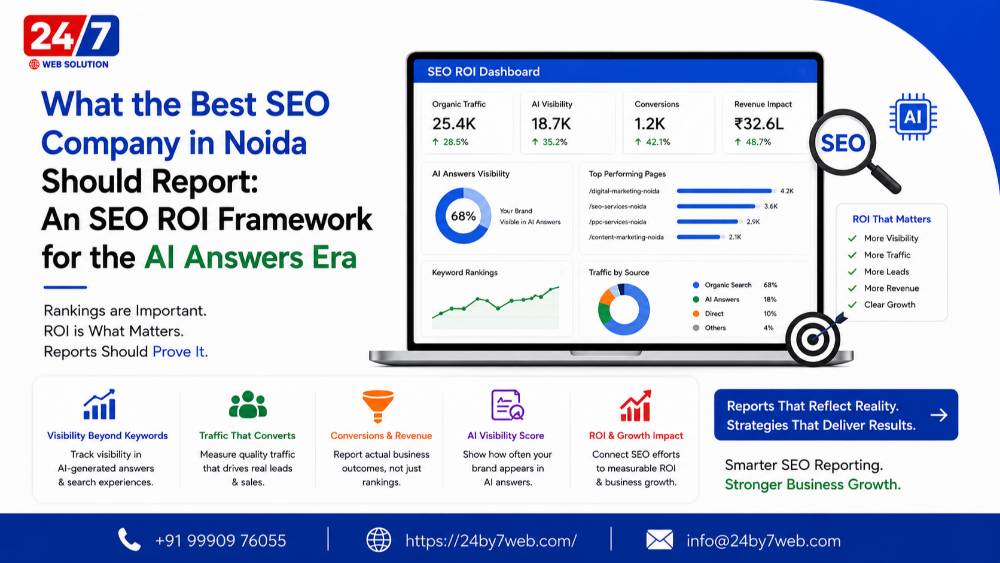
A credible SEO report in the AI answers era should cover five layers of measurement. Each layer answers a different question.
| Layer | What It Measures | Key Metrics | Why It Matters |
|---|---|---|---|
| Visibility | Are you being seen? | Keyword rankings, AI citation frequency, share of voice across AI platforms | Confirms your content is discoverable in both traditional and AI search |
| Engagement | Are people interacting? | Click-through rate, engaged sessions, scroll depth, AI referral sessions | Shows whether visibility is translating into interest |
| Conversion | Are people becoming leads? | Form submissions, calls, direction requests, chat initiations, qualified lead rate | Connects SEO activity to measurable actions |
| Business Impact | Is SEO driving revenue? | Organic pipeline, attributed revenue, organic CAC, SEO ROI | Answers the question leadership cares about most |
| AI Visibility | Are AI systems recommending you? | Citation frequency, citation quality, sentiment, share of voice in AI answers | Measures presence in the fastest-growing discovery channel |
This framework gives you a complete picture. A report that covers only the first two layers is incomplete. A report that covers all five gives you the information needed to defend SEO investment and make informed decisions.
Layer 1: Visibility Metrics
Visibility metrics confirm that your content is discoverable.
Traditional visibility metrics include keyword rankings, search impressions, and organic share of voice. These remain useful as supporting context. They tell you whether you are competing for the right queries.
AI visibility metrics are newer but increasingly important. AI search visibility measures how often and how prominently your business appears in AI-generated answers across platforms like Google AI Overviews, ChatGPT, Gemini, and Perplexity.
Google Search Console introduced Search Generative AI performance reports in June 2026. These reports provide dedicated views of impressions within generative AI features on Search, such as AI Overviews and AI Mode, with breakdowns by page, country, device, and date.
Bing Webmaster Tools launched an AI Performance dashboard in February 2026. It tracks total citations (how often your content is referenced in AI answers), average cited pages, page-level citation activity, and grounding queries — the key phrases AI used when retrieving your content. Microsoft later expanded this with Citation Share and intent/topic insights, some of which remain in preview.
These metrics matter because a business can rank number one on Google and still be invisible to ChatGPT. Measuring both traditional and AI visibility gives you a complete picture of your discoverability.
Layer 2: Engagement Metrics
Engagement metrics show whether visibility is translating into interest.
Click-through rate remains useful, but its interpretation has changed. An Ahrefs study of 300,000 keywords found that the presence of an AI Overview correlated with a 58% lower average click-through rate for the top-ranking page in December 2025, up from 34.5% in April 2025. A falling CTR is not necessarily a problem if your brand is being cited in the AI answer.
AI referral sessions are a newer engagement metric. Google Analytics 4 introduced an "AI Assistant" channel in 2026 for traffic from recognized AI assistants such as ChatGPT, Gemini, Claude, DeepSeek, Copilot, and Grok. However, Google's documentation states that this channel excludes Google AI Overviews and AI Mode, which are reported as Organic Search instead. GA4 should therefore be combined with Search Console and other AI-visibility monitoring for a complete picture.
Engaged sessions and scroll depth can provide useful behavioural context, but they should not be treated as direct predictors of future conversions without evidence from your own conversion data.
Layer 3: Conversion Metrics
Conversion metrics connect SEO activity to measurable actions.
For local businesses, these include phone calls, form submissions, direction requests, and booking clicks. Call tracking with unique numbers for your Google Business Profile listing and website landing pages gives you clear attribution.
For B2B companies, conversion metrics include demo requests, content downloads, newsletter signups, and contact form submissions. The key is to track qualified leads, not just raw lead volume. A hundred unqualified form fills are less valuable than ten qualified enquiries.
A best local SEO services in Noida provider should be able to show how local search visibility contributes to calls, direction requests, form submissions, and other tracked actions, using the attribution data available from your analytics, call-tracking, and local-search systems.
Layer 4: Business Impact Metrics
Business impact metrics answer the question your leadership team cares about most: Is SEO generating revenue?
The most important metrics at this layer include organic pipeline and revenue, organic-assisted pipeline and revenue, organic customer acquisition cost, and SEO return on investment.
Organic pipeline is the total value of sales opportunities where organic search was the first or primary touchpoint. Organic-assisted pipeline includes deals where organic played a role at any point in the journey. Multi-touch attribution is necessary to capture the full picture because SEO rarely works in isolation.
A simplified organic CAC calculation divides SEO investment by the number of customers attributed to organic search. The exact calculation depends on the attribution model and which costs and touchpoints the business includes. Comparing organic CAC to paid CAC can be informative, but the result depends on the costs, attribution model, conversion rates, sales cycle, and time horizon used in the calculation.
SEO ROI uses a simple formula: (SEO revenue minus SEO cost) divided by SEO cost. One number that fits any budget conversation.
Layer 5: AI Visibility Metrics
AI visibility metrics measure whether AI systems are recommending your business.
Citation frequency tracks how often your business appears in AI-generated answers for your target queries. Track this separately for each platform because ChatGPT citation rates may differ from Gemini or Perplexity rates.
Citation position, context, and the type of reference can be useful qualitative signals, but their business value should be validated against the visibility and conversion data available for your market.
AI citation sentiment — tracked manually or through an AI visibility monitoring platform — records what the AI says about you when it cites you. Positive recommendations drive business. Neutral mentions provide visibility. Negative citations can hurt and should be addressed.
Share of voice in AI answers measures your brand's presence relative to others in your category. If AI systems consistently recommend other businesses for your target queries, that is a competitive gap worth addressing.
What to Ask Your SEO Company Before You Sign
Before hiring any SEO company in Noida, ask these questions about reporting:
- Will you report on qualified leads and pipeline, or only on traffic and rankings?
- How will you track AI search visibility across Google AI Overviews, ChatGPT, Gemini, and Perplexity?
- Can you show me a sample report that includes business impact metrics?
- How do you separate branded and non-branded traffic in your reporting?
- Will you connect SEO data to our CRM so we can see what happens after the lead arrives?
- How do you measure the value of AI citations that do not generate clicks?
- What does your reporting look like for local SEO, including calls and direction requests?
A partner that cannot answer these questions may not yet have a mature approach to AI-search reporting.
Common Reporting Mistakes to Avoid
Several reporting practices undermine the credibility of an SEO partner.
Leading with traffic. Traffic alone is not a business outcome. If the report opens with a traffic increase but cannot connect it to leads or revenue, the story is incomplete.
Ignoring AI visibility. If your SEO company does not report on AI search visibility, you are missing a growing share of how customers discover businesses.
Using average position as a primary metric. Average position is a diagnostic tool, not a business metric. It tells you where you rank, not what that ranking is worth.
Reporting only last-click attribution. Last-click attribution undercounts SEO's contribution because it ignores earlier touchpoints. Multi-touch attribution gives a more accurate picture.
Not separating branded and non-branded traffic. Branded searches often convert at higher rates because the user already knows your business. Non-branded search growth is a better indicator of SEO effectiveness.
How to Use This Framework with Your SEO Partner
This framework is not just for evaluation. It is a tool for ongoing collaboration.
Ask your SEO partner to build their monthly report around these five layers. Review the report together and discuss what the data means for the next month's priorities. When a layer is weak, ask what will change.
The best SEO company in Noida will welcome this structure. It gives both sides a shared language for measuring success and a clear basis for decision-making. It also makes SEO conversations easier to have with leadership because every metric connects to a business outcome.
If you are looking for a partner who reports this way, 24By7 Web Solution offers SEO and digital marketing services built around measurable business outcomes. You can contact us to discuss your reporting needs or learn more about our approach.
Building an SEO Reporting Dashboard That Works
A practical SEO dashboard should answer three questions at a glance: Are we visible? Are we converting? Is it worth it?
For visibility, include traditional rankings, AI citation frequency, and share of voice in AI answers.
For conversion, include qualified leads, cost per lead, and lead-to-opportunity rate.
For business impact, include organic pipeline, attributed revenue, organic CAC, and SEO ROI.
Keep the dashboard simple. A one-page executive summary with the most important metrics is more useful than a twenty-page report that no one reads. The detailed data can live in an appendix for those who want to dig deeper.
Monthly reporting is the standard cadence for most businesses. Weekly reporting can overemphasise short-term ranking fluctuations, while monthly reporting usually provides a more useful trend window for many SEO programmes. Quarterly reports are too infrequent to catch problems early.
Frequently Asked Questions
What should an SEO report include in 2026?
An SEO report in 2026 should include visibility metrics (rankings, AI citations), engagement metrics (CTR, AI referral sessions), conversion metrics (qualified leads, calls), business impact metrics (pipeline, revenue, CAC, ROI), and AI visibility metrics (citation frequency, sentiment, share of voice).
How do I measure AI search visibility for my business?
Track citation frequency across Google AI Overviews, ChatGPT, Gemini, and Perplexity. Use Bing Webmaster Tools for AI performance data (total citations, grounding queries, page-level activity), Google Search Console for AI Overview impressions, and manual query testing for platforms without native reporting. Track citation quality and sentiment alongside frequency.
Why is traffic alone not enough to measure SEO success?
Traffic measures visits, not value. A traffic increase that does not produce qualified leads or revenue does not grow the business. In the AI answers era, many searches end without a click, so traffic alone misses the influence your content has on decisions.
What is organic customer acquisition cost, and why does it matter?
Organic CAC is a simplified calculation that divides total SEO investment by the number of customers attributed to organic search. It matters because it allows you to compare SEO efficiency against other channels. The exact calculation depends on the attribution model and which costs and touchpoints the business includes.
How often should I receive SEO reports?
Monthly is the standard cadence for most businesses. Weekly reporting can overemphasise short-term ranking fluctuations, while monthly reporting usually provides a more useful trend window. Quarterly reports miss problems until they have already impacted performance.
What is the difference between vanity metrics and business metrics in SEO?
Vanity metrics (impressions, average position, total keyword count) look impressive but do not help you make decisions. Business metrics (qualified leads, pipeline, revenue, CAC) connect SEO activity to outcomes that matter to leadership.
How do I know if my local SEO is working?
Local SEO reporting should include calls, direction requests, form submissions from local landing pages, Google Business Profile actions, and map pack positions. The most important indicator is whether local search visibility is contributing to tracked customer actions.
Can AI search visibility be tracked in Google Analytics?
Google Analytics 4 now assigns visits from AI assistants such as ChatGPT, Gemini, and Claude to an "AI Assistant" channel. However, Google's documentation states that this channel excludes Google AI Overviews and AI Mode, which are reported as Organic Search. GA4 should be used alongside Search Console, Bing Webmaster Tools, and manual AI visibility tracking for a complete picture.
What should I ask my SEO company about AI search reporting?
Ask how they track AI citations, which platforms they monitor, how they measure citation quality and sentiment, and how they connect AI visibility to business outcomes. A partner without answers may not yet have a mature approach to AI-search reporting.
How does 24By7 Web Solution approach SEO reporting?
24By7 Web Solution builds SEO reporting around measurable business outcomes: qualified leads, pipeline, revenue, and AI search visibility. The approach combines traditional SEO metrics with AI visibility tracking and connects search performance to CRM data for a complete picture of SEO impact.
Conclusion
SEO reporting is changing because search itself is changing. Rankings and traffic still matter, but they no longer tell the full story. When AI Overviews answer questions without a click, and when buyers ask ChatGPT or Perplexity for recommendations, your SEO report has to measure more than visibility on one platform.
If you are looking for an SEO partner who reports this way, 24By7 Web Solution builds SEO and digital marketing programmes around measurable business outcomes, including qualified leads, pipeline, revenue, and AI search visibility. You can contact us to discuss your reporting needs, or learn more about our approach to see how we work with businesses in Noida and across Delhi-NCR.