Quick Answer
Human-led content can provide stronger E-E-A-T signals when it adds genuine experience, original insight, accurate authorship, and editorial accountability. Google does not rank content simply according to whether AI was used. A study of more than 220 websites monitored by industry researchers found that 54% lost 30% or more of their peak organic traffic after publishing AI content at scale, though the findings are observational and do not establish that AI content alone caused those losses. For businesses in Noida, the practical approach is AI-assisted research combined with human editing, original insight, and verifiable expertise.
AI-Generated vs AI-Assisted: A Quick Definition
AI-generated content: AI produces most of the substantive copy with little meaningful human intervention before publication.
AI-assisted content: AI helps with research, outlining, ideation, or drafting, while humans verify facts, add evidence, edit for accuracy, and take responsibility for the final content.
This distinction matters more than the general question of whether AI was used at all.
Introduction
The rise of AI writing tools has changed how businesses approach content. A blog post that once took a week to produce can now be drafted in minutes. The temptation to scale content production quickly is understandable, especially for businesses trying to compete for visibility in a crowded market like Noida.
But speed is not the same as effectiveness. Data from a study of more than 220 websites that published AI-generated content shows steep organic traffic losses. Among those sites, 54% lost 30% or more of their peak organic traffic, 39% lost 50% or more, and 22% lost 75% or more. The findings show a strong pattern of traffic declines, but they do not establish that AI content alone caused those losses. The data is better treated as a warning about large-scale publishing without sufficient differentiation, quality control, or editorial oversight.
This does not mean AI has no role. Google's guidance focuses on helpful, reliable, people-first content and says its systems use a mix of signals to identify content demonstrating qualities associated with E-E-A-T, regardless of whether AI was used. The question is not whether AI was used. The question is whether the final content demonstrates genuine experience, expertise, and trustworthiness.
This guide explains how E-E-A-T works in 2026, compares human-led and AI-generated approaches, and gives you a practical framework for demonstrating credibility through your digital marketing services in Noida.
What E-E-A-T Actually Means in 2026
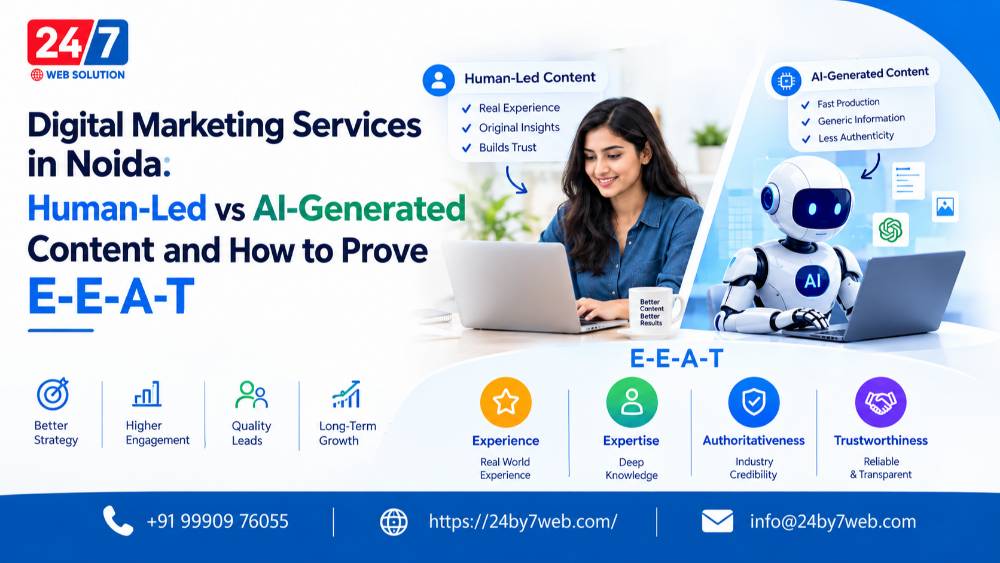
E-E-A-T stands for Experience, Expertise, Authoritativeness, and Trustworthiness. It comes from Google's Search Quality Rater Guidelines, the manual human raters use to evaluate search results.
Google's own documentation says: "While E-E-A-T itself isn't a specific ranking factor, using a mix of factors that can identify content with good E-E-A-T is useful." In other words, E-E-A-T is not a single ranking signal you can optimise for directly. It describes qualities that Google's systems use a range of signals to identify.
The four parts work together. Experience asks whether the creator has first-hand involvement with the topic. Expertise looks at knowledge and demonstrated competence. Authoritativeness measures recognition and reputation. Trust ties everything together by evaluating accuracy, transparency, and reliability.
Google's guidelines state that trust is the most important member of the E-E-A-T family. The others contribute to trust, but content doesn't necessarily have to demonstrate all of them.
E-E-A-T considerations are relevant across topics, although the amount and type of expertise required can vary depending on the subject and user intent. Google added Experience to E-A-T in December 2022 to account for the value of first-hand experience, particularly where practical experience can help satisfy a user's needs. Every business in Noida competing for organic visibility should treat E-E-A-T as a baseline consideration, not an optional extra.
Human-Led vs AI-Generated Content: What the Data Shows
The debate between human and AI content is often framed as a binary choice. The reality is more nuanced.
Google's official stance is that it rewards original, high-quality content that demonstrates E-E-A-T, regardless of whether AI is used. Google's helpful content system, integrated into core ranking systems in March 2024, evaluates entire websites and can impact rankings if substantial unhelpful content is detected.
The important distinction is between fully AI-written content and AI-assisted content. Fully AI-written content is copy generated and published with no meaningful human editing. AI-assisted content uses AI as a drafting or research tool while a human editor shapes the final output, adds original insight, and fact-checks claims.
An Ahrefs study of 331,000 pages found that 86.5% of top-ranking pages were classified by Ahrefs' methodology as containing some AI-generated content. Pages with under 50% AI content account for 82.2% of top-three rankings. In Ahrefs' analysis, pages with higher AI-content scores ranked lower on average, with the average AI content score rising from 27.1% at position 1 to 30.9% at position 10. Because AI-detection systems are probabilistic, these figures should be interpreted as estimates of AI-content presence rather than definitive records of how each page was produced.
What fails is content that lacks differentiation. The failures tend to follow the same patterns: thin content with no original perspective, factual inaccuracies left unchecked, and near-identical output that ends up drowning in a sea of AI-generated pages covering the same topic in the same words.
Why Human Experience Cannot Be Generated
Google's decision to add the second E to E-A-T in December 2022 was deliberate. The goal was to acknowledge that theory alone does not always satisfy user intent. Experience allows Google to surface content written by people who have been through the process themselves.
The rater guidelines offer a clear example: a product review from someone who has personally used the product carries more weight than a review by someone who has not. AI can describe or simulate an experience, but a prompt can generate an idea or recommendation without turning an unobserved claim into genuine first-hand experience.
This is why demonstrating experience matters. Clear author bios, original photos or videos, documented processes, and real examples all help signal that your content comes from lived involvement, not just research.
For a digital marketing company in Noida, this means the most valuable content comes from people who have actually executed campaigns, tested tactics, and learned from results.
Comparison Table: Human-Led vs AI-Generated Content
| Aspect | Human-Led Content | Fully AI-Generated Content |
|---|---|---|
| Experience signals | First-hand knowledge, original examples, documented processes | Cannot produce genuine experience; relies on patterns from training data |
| Expertise | Demonstrated through credentials, work history, and verifiable results | Can communicate existing information, but the content itself does not establish the real-world competence of a human creator |
| Authoritativeness | Built through citations, backlinks, and industry recognition | No independent authority; relies on the credibility of the source it was trained on |
| Trustworthiness | Fact-checked, transparent, accountable to a real author | Prone to inaccuracies, lacks accountability, may include fabricated details |
| Original insight | Can contribute first-hand observations, original data, and informed perspective | May generate plausible ideas but cannot independently establish first-hand observations or original business data |
| Google guidance | Aligns with people-first content principles | Acceptable if high-quality and human-reviewed; risky at scale without oversight |
| Ranking data | 82.2% of top-three pages classified by Ahrefs as under 50% AI content | 5.3% of top-three pages classified by Ahrefs as 100% AI-generated |
How Google Evaluates AI Content in 2026
Google's guidance on creating helpful content now warns against fabricated author profiles. AI-generated headshots, made-up names, and false credentials used to imply human expertise are described as a form of deception. Google says any form of deception makes a page untrustworthy to both users and its automated quality systems, and is a signal of a low-quality page.
The rater guidelines tell raters to treat fake creator profiles, AI-generated author images, and false claims of expertise as deception. Pages that use deception receive the lowest rating.
Google has also developed SynthID, a watermarking and identification technology used across supported Google AI products. SynthID is not a universal detector for all AI-generated web content. It is primarily a watermarking tool for content generated by supported Google AI systems.
Bing has also updated its Webmaster Guidelines to cover AI content. The previous guidelines treated machine-generated content as malicious. The new version says: "Large-scale content generated without oversight, quality control, or editorial review often lacks usefulness, accuracy, and originality, and may be excluded from indexing." The line has moved from all machine-generated content to content produced without editorial oversight.
How to Demonstrate E-E-A-T Through Digital Marketing Services
Demonstrating E-E-A-T is not about adding badges or claims to your website. It is about showing credibility through verifiable signals. Here is a practical framework for businesses working with a digital marketing strategy.
1. Document Real Experience
Create content that reflects actual work. Case studies with specific details about what was tested, what worked, what did not, and what changed as a result. Documented processes, project logs, and before-and-after examples all signal first-hand involvement.
2. Add Verifiable Author Information
Author bios should be accurate and verifiable. Avoid AI-generated headshots or made-up credentials. Google's guidance is explicit: fabricated creator profiles are a form of deception. Real names, real credentials, and real professional histories build trust.
3. Cite Authoritative Sources
When you make factual claims, link to primary sources. Google's rater guidelines evaluate whether content is accurate and reliable. Citing research, official documentation, and industry data shows that your content is grounded in evidence rather than assumption.
4. Build Topical Authority
Google's systems consider more than the wording of a single page. Site-wide quality signals, authorship information, reputation, and the consistency of information can all contribute to how content is understood. Building depth in a specific topic area is more effective than publishing broadly on unrelated subjects.
5. Maintain Editorial Oversight
AI can be a useful research and drafting tool. The critical step is human editorial review. Fact-checking, adding original insight, and ensuring brand voice consistency are not optional extras. They are the difference between content that holds traffic and content that fades.
6. Track What Actually Matters
Monitor AI citation frequency, organic traffic trends, and conversion data together. If a decline in traffic lines up with a spike in AI output, that page is worth a rewrite grounded in original data or firsthand experience.
The Role of AI in a Human-Led Content Strategy
AI can fit within an E-E-A-T-focused workflow when people remain responsible for research, verification, authorship, and final editorial decisions. The most effective approach treats AI as a research accelerator and drafting assistant, not as a replacement for human judgment.
A study of more than 220 websites found that sites losing 75% or more of peak traffic were associated with AI-content platforms used as a primary growth strategy. The analysis reported substantial traffic declines among many sites using AI-content platforms, but the study does not establish that AI publishing alone caused those losses.
For an SEO company in Noida, this means using AI to accelerate research and drafting while retaining human responsibility for verification and quality control. Content that performs sustainably should provide clear value to the reader rather than relying on production volume alone.
How E-E-A-T Supports AI Search Visibility
For AI answer engines such as ChatGPT, Gemini, and Perplexity, the same fundamentals remain useful: clear factual claims, identifiable entities, authoritative sources, original information, and content that directly answers the query.
For Google AI Overviews and AI Mode, the same people-first SEO fundamentals remain important: useful content, clear answers, original information, strong sourcing, and a technically accessible page.
Many traditional search fundamentals also matter for AI search visibility, including crawlability, clear structure, focused content, explicit facts, and supporting evidence. Bing specifically documents these considerations for content used in AI-generated answers.
Where measurement is available, monitor how often your content is cited in AI-generated answers, including Bing Webmaster Tools' AI Performance reporting for supported Microsoft AI experiences. Bing's AI Performance dashboard reports total citations, cited pages, average cited pages, grounding queries, and page-level citation activity. Bing explicitly notes that these metrics do not represent rankings, authority, or importance.
Building an E-E-A-T Framework for Your Noida Business
A practical E-E-A-T framework for digital marketing services in Noida should cover four areas.
Content creation. Every piece of content should answer a real question, include original insight, and cite verifiable sources. Avoid publishing content that simply restates what already exists elsewhere.
Author credibility. Make it easy for readers and search systems to understand who created the content and why they are qualified. Accurate bylines, professional bios, and links to relevant work all contribute.
Technical transparency. Ensure your website has clear contact information, privacy policies, and terms of service. Trustworthiness includes basic signals that your business is real and accountable.
Ongoing measurement. Track AI visibility through tools like Bing Webmaster Tools' AI Performance dashboard, which reports total citations and grounding queries. Monitor how often your content is cited in AI-generated answers across platforms.
If you are looking for a partner who builds content around these principles, 24By7 Web Solution offers digital marketing services in Noida with a focus on human-led content and measurable outcomes. You can contact us to discuss your content strategy or learn more about our approach.
Frequently Asked Questions
Does Google penalize AI-generated content?
Google does not penalize content simply because it was produced with AI. Google's ranking systems aim to reward original, high-quality content that demonstrates E-E-A-T, regardless of production method. What Google penalizes is content created primarily to manipulate rankings, or large-scale content generated without editorial oversight that lacks usefulness, accuracy, and originality.
Can AI-generated content rank on Google?
Yes, AI-generated content can rank. An Ahrefs study found that 5.3% of top-ranking pages (positions 1–3) were classified as 100% AI-generated, and 86.5% of top-ranking pages were classified by Ahrefs' methodology as containing some AI-generated content. In Ahrefs' analysis, pages with higher AI content scores ranked lower on average, with the average AI content score rising from 27.1% at position 1 to 30.9% at position 10.
What is the difference between AI-generated and AI-assisted content?
Fully AI-generated content is copy produced and published with no meaningful human editing. AI-assisted content uses AI as a drafting or research tool while a human editor shapes the final output, adds original insight, and fact-checks claims. The editorial process is one of the most important variables because it determines whether AI-assisted material is fact-checked, differentiated, and grounded in genuine expertise.
How long does it take to see results from human-led content?
There is no fixed timeframe. Results depend on competition, domain authority, content quality, and search demand. Content that demonstrates genuine expertise and answers real questions can gain traction within a few months. Competitive topics may take longer. The key is consistency and depth rather than volume.
What are the biggest E-E-A-T mistakes businesses make?
Fabricating author profiles is one of the most serious mistakes. Google's guidance explicitly warns against AI-generated headshots, made-up names, and false credentials used to imply human expertise. Other common mistakes include publishing thin content with no original perspective, failing to cite sources, and scaling AI output without editorial review.
How do I prove experience in my content?
Document real work. Case studies with specific details about what was tested, what worked, and what changed are the strongest signals. Original photos, videos, project logs, and before-and-after examples all demonstrate first-hand involvement. Google's rater guidelines specifically value content from creators who have personally used a product or been through a process.
Is AI content detection reliable?
AI detection tools are not perfect. A detector score is an estimate of how much of a page reads as AI-written, not a record of who wrote it. The more important question is whether the content provides genuine value, demonstrates expertise, and is fact-checked. Building for quality is more sustainable than trying to evade detection.
How does Bing treat AI-generated content?
Bing's updated Webmaster Guidelines focus on content produced without editorial oversight rather than all machine-generated content. Large-scale content generated without oversight, quality control, or editorial review may be excluded from indexing. Bing also recommends placing essential information near the top of the page and focusing each URL on a single topic.
What is GEO, and how does it relate to E-E-A-T?
GEO stands for Generative Engine Optimization. Bing's current Webmaster Guidelines describe GEO as focusing on content eligibility for grounding and reference in AI responses. GEO does not guarantee citations. E-E-A-T and GEO are complementary: demonstrating expertise, evidence, and trustworthy authorship can strengthen the quality and usefulness of content intended for AI retrieval, but it does not guarantee selection as a grounding source.
How can 24By7 Web Solution help with E-E-A-T and human-led content?
24By7 Web Solution builds content strategies around demonstrated expertise, original insight, and verifiable credibility. The approach combines AI-assisted research with human editorial oversight, ensuring every piece of content meets Google's people-first standards. You can contact us to discuss your content needs.
Conclusion
For most businesses, the practical choice is not between AI and human writing in isolation. It is how AI is used within a human-led editorial process.
Google's systems use a range of signals that can help identify content demonstrating qualities associated with E-E-A-T. That means content that reflects real experience, shows verifiable expertise, builds authority through consistent quality, and maintains trust through accuracy and transparency. AI can help you produce more content, and it can help generate ideas and surface information. What it should not do is substitute for genuine expertise or original findings that were never actually observed.
For businesses in Noida, the opportunity is clear. Content that demonstrates real expertise can strengthen visibility, support citation eligibility in AI search, and build reader trust. Content that simply fills space with generic information will not. In Ahrefs' analysis, pages with higher AI-content scores ranked lower on average, and sites that scale AI without editorial oversight tend to show traffic declines over time.
A human-led strategy can use AI for research and drafting while keeping fact-checking, original analysis, and final editorial judgment with people. Build author credibility and cite authoritative sources. Track AI citation frequency alongside traditional metrics.
If you are looking for a partner who builds content this way, 24By7 Web Solution offers digital marketing services in Noida built around measurable outcomes and genuine expertise. You can contact us to discuss your content strategy, or learn more about our approach to see how we work with businesses in Noida and across Delhi-NCR.