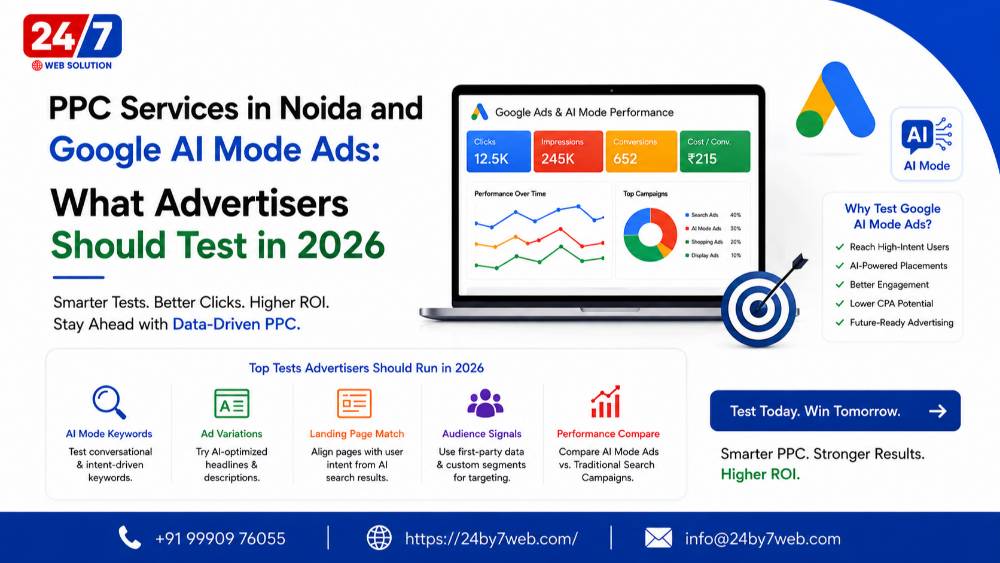
Quick Answer: Google AI Mode is becoming an additional paid-search surface. In a June 2026 SE Ranking study of 50,032 commercial US keywords , text ads appeared on 29.45% of AI Mode queries that triggered a website ad. Advertisers should test AI Mode carefully, keep measurement separate where possible, and evaluate conversions and query quality rather than clicks alone. AI Mode advertising should also be treated separately from organic citations and traditional Search rankings.
Here is how AI Mode ads differ from standard Search ads:
| Dimension | Traditional Search | AI Mode |
|---|---|---|
| User interaction | Keyword or search query | Conversational question with follow-ups |
| Ad experience | Search ad formats | AI Mode-specific formats and sponsored recommendations |
| Creative | Advertiser assets plus Google optimisation | Google can use AI to adapt creative and provide contextual explanations |
| Placement | Search results page | Within or around AI-generated experiences |
| Organic citation | Separate from ads | Separate from paid placement |
| Measurement | Standard Google Ads metrics | Standard paid metrics plus AI Mode query-context analysis where available |
Google's advertising landscape is shifting faster than most businesses can track. Ads began appearing inside AI Mode responses in late 2025, according to SE Ranking's research. Google announced two new formats at Google Marketing Live in May 2026. And Google reported that AI Mode had surpassed 75 million daily active users by late 2025, according to Google's Q3 2025 earnings communication.
For businesses in Noida, this is not a distant trend. It is happening in the same search ecosystem your customers already use. For Noida businesses, the practical question is how to test AI Mode advertising without disrupting established paid-search performance.
This guide covers what advertisers should test in Google AI Mode Ads in 2026, how PPC services in Noida are adapting, and what practical steps local businesses can take right now.
What Is Google AI Mode?
Google AI Mode is a conversational search experience where users ask full questions and receive AI-generated answers instead of a standard list of links. It sits alongside AI Overviews but is a separate surface that users choose to enter.
The advertising model works differently from traditional Search. Here is what makes it distinct:
For feed-based and Shopping experiences, Google's systems can use Merchant Center data and other signals to generate or adapt ad creative. That does not mean advertisers have no control over the underlying campaign inputs. Product information, feed quality, and campaign settings still shape what Google's systems produce.
Google announced two new formats in testing. At Google Marketing Live 2026, Google introduced Conversational Discovery ads and Highlighted Answers. Conversational Discovery ads generate creative tailored to a specific query, paired with an independent Gemini-written explainer. Highlighted Answers make ads eligible to appear inside AI Mode's list-style recommendations.
In SE Ranking's June 2026 dataset, 71.1% of ad-triggering AI Mode queries showed two ad items. Only 28.9% showed one.
In SE Ranking's dataset, higher CPC keywords triggered ads more often. Ad presence was 24.33% for keywords below $2 CPC, but rose to 53.56% for keywords at $10 or higher.
Buying an ad does not earn you a citation. In the same dataset, only 11.53% of advertiser domains appeared among the cited sources for the keywords they advertised on. At the URL level, that overlap fell to 1.95%.
The practical implication is that paid placement and AI citations should be measured separately. Paying for placement does not improve your organic citation share.
Important note on the data
The SE Ranking figures cited here come from US AI Mode data collected in June 2026. They should not be treated as direct benchmarks for Indian or Noida advertisers. AI Mode ad behaviour can vary by market, query, account and time. Indian advertisers should validate actual availability and performance within their own Google Ads accounts.
How AI Mode Advertising Works in 2026
AI Mode advertising sits inside Google's broader Search ecosystem rather than replacing it. For most advertisers, the practical shift is about which parts of campaign execution Google's systems now handle, and which parts remain the advertiser's responsibility.
The advertiser still controls goals, budget, inputs, and measurement. Google's systems increasingly handle matching, creative adaptation, and placement decisions across Search, AI Mode, and other surfaces.
This is why testing AI Mode is less about building a completely new campaign type and more about understanding what happens when your existing inputs flow into a new placement.
What the June 2026 Data Shows
The early data is mixed. AI Mode ads are growing quickly, but they are not a straightforward replacement for Search ads.
| Metric | Finding | Source |
|---|---|---|
| Ad presence on commercial queries | 29.45% | SE Ranking study of 50,032 US keywords |
| Two ads shown together | 71.1% of ad-triggering queries | SE Ranking |
| Advertiser cited as source | 11.53% of advertiser domains | SE Ranking |
| URL-level citation overlap | 1.95% | SE Ranking |
| Advertised URLs also ranking organically | 2.32% | SE Ranking |
| CPC threshold for higher ad presence | 53.56% at $10+ CPC | SE Ranking |
The June 2026 SE Ranking dataset provides evidence that paid placement and organic AI citations are largely separate visibility layers. The dataset does not show evidence that buying these ad placements increases organic citation or ranking visibility.
The other finding worth noting is variation by niche. SE Ranking found substantial differences between categories. In its dataset, some lead-generation categories showed high ad presence, while informational and YMYL categories showed much lower rates.
For a business in Noida, this suggests that AI Mode testing should start with campaigns that already have strong conversion tracking and clear lead intent.
What Advertisers Should Test
Testing AI Mode ads does not require abandoning your existing campaigns. A controlled test can make the results easier to evaluate: use a limited learning budget, separate tracking where possible, and define success criteria before scaling.
1. Start with a Controlled Learning Budget
The most common mistake advertisers make with new placements is over-committing too early. There is no Google-prescribed percentage for an AI Mode testing budget.
For a new placement, advertisers can use a deliberately limited learning budget that is small enough to protect established campaigns while still generating enough data to evaluate the test. For some businesses, that may mean allocating a small percentage of existing paid-search spend rather than moving a large portion of the budget immediately.
The goal is to learn whether AI Mode works for your business before it becomes a meaningful line item.
2. Protect Your Established Campaigns
Protect your established campaigns while you learn. Where campaign controls and reporting allow, isolate the experiment or use Google's available experiment and reporting tools so you can distinguish established performance from new AI-driven placements.
If AI Mode performs poorly for your audience, your core campaigns remain unaffected.
3. Track Query Quality, Not Just Clicks
AI Mode clicks can be misleading on their own. Watch for conversion lag, assisted paths, and total conversion volume. A query that produces a click but no downstream action may indicate that the AI Mode placement is reaching users at the wrong stage of their journey.
For Noida businesses, this matters because local intent can be highly transactional. If AI Mode ads are reaching researchers rather than buyers, the placement may not suit every campaign type.
4. Test Both New Formats Separately
Conversational Discovery ads and Highlighted Answers behave differently. Conversational Discovery ads respond to specific user questions with tailored creative and an independent Gemini explainer. Highlighted Answers place ads inside AI Mode's recommendation lists, such as "best language learning apps for an upcoming trip."
These formats suit different campaign objectives. Test them as separate ad groups or campaigns so you can compare performance without mixing signals.
5. Review AI Max Readiness
Google recommends using AI Max for Search and AI Max for Shopping as part of the foundation for its newer AI-powered advertising experiences. If your campaigns are not yet structured for AI-driven search, now is a practical time to review settings, feed quality, and conversion tracking.
6. Review Landing-Page Readiness
AI-driven ad systems can use landing-page content as part of their inputs. Review titles, descriptions, service information, pricing where applicable, conversion paths, and claims before increasing automation. Google's documentation specifically advises advertisers to keep website content accurate and aligned with the products or services being advertised.
This step matters for CRO as much as for PPC. A well-structured landing page improves conversion rates whether the visitor arrives from a traditional Search ad, an AI Mode ad, or an organic AI citation.
The practical funnel looks like this: Query ? AI Mode ad ? landing page ? conversion ? qualified lead. Each step needs to work for the test to produce meaningful data.
What AI Mode Means for Noida Advertisers
For Noida businesses, AI Mode testing needs to account for the difference between broad informational searches and locally qualified commercial searches. A query such as "PPC services for a Noida B2B company" carries a different intent from a general question about PPC pricing.
Here is how different business types might approach AI Mode testing:
| Business Type | What to Watch | Practical Focus |
|---|---|---|
| Local service businesses | Whether AI Mode reaches customers with immediate intent | Calls, forms, bookings and other qualified local actions |
| B2B companies | Longer research cycles and assisted conversions | Multi-touch attribution, not just last-click |
| Ecommerce | Feed quality and product information accuracy | Merchant Center data and product page readiness |
| Education and training | Query intent across awareness and decision stages | Form completions and enquiry quality |
| Healthcare and professional services | Compliance and YMYL sensitivity | Careful creative, strong trust signals |
The key question is not which category "wins" in AI Mode, but whether the placement reaches relevant commercial intent for your specific business.
AI Mode in India
Google's AI Mode is also developing in India. Google has expanded conversational shopping experiences in AI Mode for Indian users, including product information such as pricing, reviews and inventory. This makes AI Mode particularly relevant for ecommerce advertisers, although businesses should still validate actual ad availability and performance within their own Google Ads accounts.
What Google Changed in 2026
Several Google Ads updates in 2026 affect how AI Mode testing fits into a broader PPC strategy.
AI Max Auto-Upgrade
Starting in September 2026, Google began automatically upgrading eligible Search campaigns using text customization (formerly automatically created assets) or the campaign-level broad match setting to AI Max for Search. Search term matching and text customisation are switched on by default.
Advertisers using these settings should review their campaign configuration and reporting so they understand how the AI Max transition affects their Search campaigns.
Asset Studio and Gemini-Powered Creative Tools
Google is launching new features in Asset Studio that connect brand guidelines to Gemini models for faster creative production, as announced at Google Marketing Live 2026. For advertisers testing AI Mode formats, this reduces the friction of producing the varied creative that conversational ads may require.
Ask Advisor
Google announced Ask Advisor, a Gemini-powered cross-product agent connecting Google Ads, Google Analytics, Merchant Center and Google Marketing Platform. Google describes it as an always-on strategic partner that connects data across products. It is being introduced as a beta experience.
For advertisers, the practical change is that more execution is moving into Google's automated systems, while advertisers retain responsibility for goals, inputs, measurement and controls.
AI Mode Ads vs Organic AI Citations
This is one of the most important distinctions for advertisers in 2026. There are three separate visibility layers in AI-driven search.
| Visibility Layer | How It Works | Can PPC Directly Buy It? |
|---|---|---|
| Traditional organic | Ranking systems determine position | No |
| AI citations | Sources selected and presented within AI-generated answers | No |
| AI Mode advertising | Sponsored placements | Yes, where available |
These layers can overlap, but one does not automatically produce the other. Buying an AI Mode ad does not increase your chances of being cited as a source in the same AI response. Ranking organically does not automatically earn you a citation either.
For advertisers, this means AI Mode ads should be treated as a paid visibility channel with its own metrics and its own logic. Expecting them to lift organic performance or replace traditional Search campaigns will lead to poor decisions.
Practical Testing Framework
Here is a simple framework for testing AI Mode ads without disrupting your existing campaigns.
| Step | Action | What to Watch |
|---|---|---|
| 1. Budget | Set a limited learning budget that protects core spend | Do not pull budget from proven campaigns |
| 2. Structure | Where possible, keep the test distinguishable from established campaigns and baseline performance | Use available controls, experiments, and reporting |
| 3. Creative | Ensure feed data and product information are complete and accurate | Feed-based formats draw on this data |
| 4. Tracking | Track impressions, query context, and assisted conversions alongside clicks | Clicks alone are not enough |
| 5. Formats | Test Conversational Discovery and Highlighted Answers separately | They suit different campaign objectives |
| 6. Duration | Run the test long enough to see conversion lag | Initial click data can be misleading |
| 7. Decision | Scale, pause, or adjust based on total conversion volume | Do not judge on clicks alone |
Need help evaluating an AI Mode PPC test? Review your campaign structure, conversion tracking, landing pages, and budget before moving more spend into AI-driven placements. Explore our PPC services in Noida to see how we approach this.
What Not to Expect from AI Mode Ads
AI Mode ads are not a shortcut to organic visibility. The June 2026 SE Ranking dataset found very limited overlap between advertisers, AI citations, and organic results. That supports treating paid AI Mode visibility as a separate channel rather than an SEO shortcut.
Buying an AI Mode ad does not increase your chances of being cited as a source in the same AI response. In that dataset, only 11.53% of advertiser domains appeared among the cited sources for the keywords they advertised on. At the URL level, that overlap fell to 1.95%.
Similarly, advertised URLs rarely ranked organically for the same keywords where their ads appeared. Only 2.32% of advertised URLs ranked organically for the queries where their ads showed.
This means AI Mode ads should be treated as a paid visibility channel with its own metrics and its own logic. Expecting them to lift organic performance or replace traditional Search campaigns will lead to poor decisions.
Frequently Asked Questions
1. What are Google AI Mode ads?
Google AI Mode ads are sponsored placements that appear inside AI-generated answers when users ask conversational questions. For feed-based and Shopping experiences, Google's systems can use Merchant Center data and other signals to generate or adapt ad creative. Google has announced two new formats in testing: Conversational Discovery ads and Highlighted Answers.
2. How often do AI Mode ads appear on commercial queries?
A June 2026 SE Ranking study of 50,032 commercial US keywords found that text ads appeared on 29.45% of AI Mode queries that triggered a website ad. The study notes that AI Mode results can vary between sessions, so the figure is a snapshot rather than a universal rate.
3. Do AI Mode ads help with organic rankings or citations?
No. The same SE Ranking dataset found that only 11.53% of advertiser domains appeared among the cited sources for the keywords they advertised on. At the URL level, that overlap fell to 1.95%. AI Mode ads are a separate visibility channel from organic results and citations.
4. How much budget should I allocate to AI Mode testing?
There is no Google-prescribed percentage for an AI Mode testing budget. Advertisers can use a deliberately limited learning budget that is small enough to protect established campaigns while still generating enough data to evaluate the test. For some businesses, that may mean allocating a small percentage of existing paid-search spend rather than moving a large portion of the budget immediately.
5. What formats should I test first?
Conversational Discovery ads and Highlighted Answers are the two main AI Mode formats currently in testing. Test them as separate ad groups or campaigns so you can compare performance without mixing signals.
6. Does AI Mode work for local businesses in Noida?
For local businesses, the key question is whether AI Mode reaches relevant commercial intent and whether the advertiser has reliable conversion tracking. Ecommerce advertisers may also benefit from well-maintained Merchant Center data. Local availability and ad behaviour can vary by market, so validate within your own account.
7. What is AI Max, and how does it relate to AI Mode?
AI Max is Google's AI-powered campaign solution for Search, with AI Max for Shopping also available for eligible retail campaigns. Google recommends using AI Max as part of the foundation for its newer AI-powered advertising experiences. Starting in September 2026, eligible campaigns using text customization or campaign-level broad match began upgrading to AI Max for Search.
8. Should I pause my existing Search campaigns to test AI Mode?
Usually, a new AI Mode test should not require abandoning campaigns that are already producing reliable results. Instead, advertisers should use available campaign controls, experiments, and reporting to isolate what they are learning.
9. How long should I run an AI Mode test before deciding?
There is no universal test duration. Run the test until you have enough qualified conversion data to compare it with your existing paid-search baseline. For longer sales cycles, include assisted and delayed conversions rather than judging the test from early clicks alone.
10. What should I ask a PPC service provider in Noida about AI Mode?
Ask how they plan to test AI Mode, how they will track performance beyond clicks, how they will keep the test separate from your core campaigns, and what success metrics they will use. A PPC service provider in Noida should be able to explain this in plain language and show you how the test connects to business outcomes.
About 24By7 Web Solution
24By7 Web Solution is a digital marketing and PPC services provider based in Noida. The company works with businesses on paid search, conversion tracking, and digital marketing strategy. For questions about your own AI Mode testing approach, you can contact us, read more about our team, or explore our Digital marketing services in Noida.