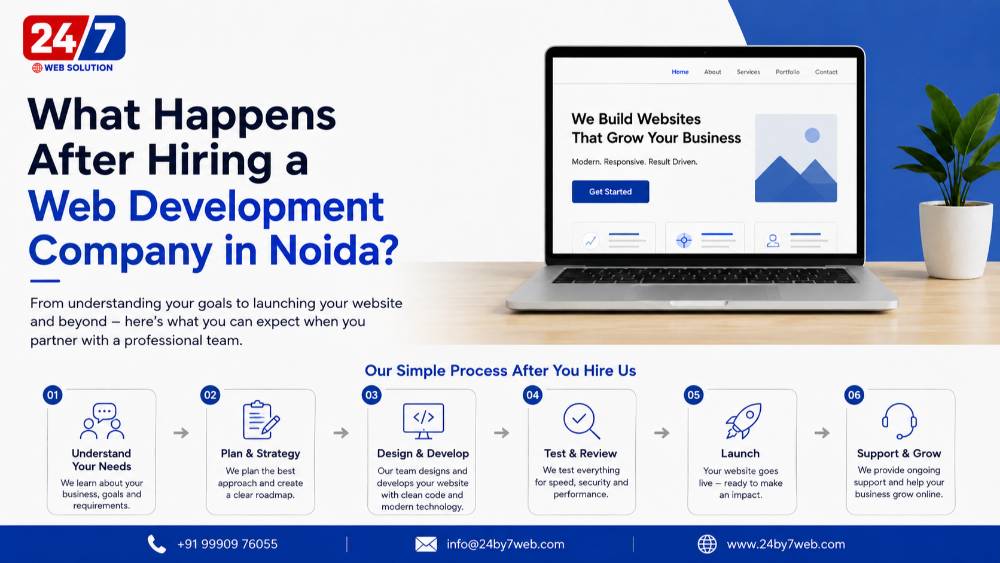
After hiring a web development company in Noida, you can expect a structured process that typically includes discovery and requirement gathering, planning and strategy, design and prototyping, development and coding, testing and quality assurance, launch and deployment, and ongoing support and maintenance. The entire journey from kickoff to launch usually takes between 3 to 20 weeks depending on project complexity.
Why Trust This Guide?
| Trust Signal | Details |
|---|---|
| Updated for 2026 | Latest web development processes and best practices |
| Industry Research | Data from Cloudflare, Google, and security reports |
| Real-World Experience | Based on 12+ years of web development projects |
| Local Market Focus | Noida, Delhi NCR, and Indian business context |
| Actionable Insights | Checklists, comparison tables, and practical guidance |
This guide is based on real-world experience, industry research, and practical expertise in managing web development projects.
AI Summary
A professional web development company in Noida follows a structured website development lifecycle where planning, UI/UX design, coding, testing, deployment, SEO implementation, and ongoing optimization are completed step by step to deliver a scalable and high-performing website. The process includes discovery, planning, design, development, testing, launch, and post-launch support phases. This structured approach ensures your project stays on track and delivers measurable results.
Why This Guide Matters
Whether you are building your first business website or upgrading an enterprise platform, understanding what happens after hiring a web development company in Noida helps you avoid delays, reduce development costs, improve collaboration, and launch a website that is faster, SEO-ready, scalable, and optimized for both users and AI search engines. Knowing the process also helps you set realistic expectations and stay actively involved at the right stages. Businesses across Noida Sector 62, Sector 63, Sector 18, Sector 125, Greater Noida, Noida Extension, and Delhi NCR benefit from understanding this journey.
Key Takeaways
- Discovery always comes before coding.
- Website planning affects SEO performance.
- Testing reduces launch risks significantly.
- Staging environment prevents live website issues.
- Post-launch maintenance protects search rankings.
- Structured development saves time and cost.
- Continuous optimization improves AI visibility.
In Simple Words
Hiring a web development company in Noida means entering a structured website development lifecycle where planning, UI/UX design, coding, testing, deployment, SEO implementation, and ongoing optimization are completed step by step to deliver a scalable and high-performing website. The process follows a clear roadmap with regular check-ins, milestone reviews, and client involvement at every stage. This systematic approach ensures your website is built right the first time, saving you time and money in the long run.
Need help planning your website project? Talk to our web development experts at 24By7 Web Solution.
How AI Search Engines Understand This Topic
AI search engines evaluate web development content based on structure, clarity, and technical accuracy.
Google AI Overviews look for clear phase-by-phase explanations, structured data, and authoritative sources when selecting content to display in AI-generated summaries.
ChatGPT Search extracts key information about timelines, deliverables, and best practices from well-structured articles with clear headings and tables.
Gemini analyzes website structure, content hierarchy, and semantic HTML to understand and reference information about web development processes.
Claude evaluates content clarity, depth, and logical flow when determining relevance for user queries about website development.
Perplexity prioritizes websites with strong authority signals, structured content, and clear information hierarchy.
DeepSeek focuses on well-structured, semantically rich content with proper HTML hierarchy and machine-readable data.
Bing Copilot uses authority signals, content quality, and technical SEO factors when selecting sources for AI-generated answers.
Introduction
You have signed the contract. You have made the decision. Now what?
Many business owners hire a web development company in Noida with high expectations but little understanding of what happens next. Some expect coding to start immediately. Others worry about being left in the dark.
The reality is that professional web development companies follow structured processes to deliver successful websites. Understanding this process helps you know what to expect, when to provide input, and how to ensure your project stays on track.
In this comprehensive guide, we will walk you through exactly what happens after you hire a website development company Noida. From the initial discovery phase to post-launch support, we will cover every step of the journey.
Whether you are a first-time website owner or have worked with developers before, this guide will help you navigate the web development process with confidence.
Phase 1: Discovery and Requirement Gathering
The first phase begins immediately after you sign the agreement. Contrary to what many clients expect, coding does not start right away.
Key Insight
Discovery includes stakeholder meetings, business analysis, requirement gathering, competitor research, technical planning, and project documentation before development begins.
What Happens During Discovery
During this phase, the best web development company in Noida takes time to understand your business, goals, and requirements. This typically involves:
- Kickoff meetings – Initial discussions with your team and stakeholders
- Requirement gathering – Identifying business objectives, target audience, and functional needs
- Competitor analysis – Understanding what works in your industry
- Technology selection – Choosing the right platform and tech stack
Professional agencies follow structured processes during this phase. According to industry best practices, key steps include planning discovery objectives, identifying and engaging the right stakeholders, gathering detailed business and strategic requirements, analyzing the target audience, and defining both functional (e.g., e-commerce, forms) and non-functional (e.g., performance, security) requirements.
Real Experience
In most website projects handled by our team at 24By7 Web Solution, businesses initially focus on homepage design and basic functionality. However, after reviewing user behavior during the discovery phase, many clients realize they need additional features like customer portals or integration with existing CRM systems. Identifying these requirements early prevents costly redevelopment later.
Expert Tip
Finalize your sitemap before design starts. Structural changes after development begins increase project time and may require rebuilding templates. A well-planned sitemap saves weeks of development time.
What Is Website Discovery?
Website discovery is the initial planning phase where business objectives, user requirements, technical specifications, project scope, and success metrics are defined before design or development begins.
Your Role as the Client
During discovery, you should expect to:
- Attend kickoff meetings
- Provide business goals and audience insights
- Share brand guidelines and existing assets
- Answer questions about your industry and competitors
- Review and approve project scope documents
A good web development company in Noida will guide you through this process and make it easy to provide the information they need.
Deliverables
By the end of the discovery phase, you should receive:
- Project scope document
- Technology recommendations
- Timeline estimates
- Functional requirements specification
- Sitemap or information architecture
Why Discovery Matters for SEO
The discovery phase is also where technical SEO requirements are defined. Understanding your target keywords, audience intent, and content structure early ensures your website is built with search visibility in mind. Core Web Vitals and performance goals are also established during this phase.
Starting your website journey? Contact 24By7 Web Solution for expert guidance through every phase.
Phase 2: Planning and Strategy
Once requirements are clear, the website development company Noida moves into the planning phase.
Key Insight
Planning involves creating a project roadmap, information architecture, wireframes, and technology architecture documentation before any design or development begins.
What Happens During Planning
During this phase, the development team creates a detailed roadmap for your project. This includes:
- Project roadmap – A timeline with key milestones
- Information architecture – Structuring your website's content
- Wireframing – Creating low-fidelity layouts for key pages
- Technology architecture – Defining the technical foundation
Many agencies consider planning and wireframing essential steps before any design or development work begins. This phase typically takes 4-6 weeks for complex projects using agile web development methodologies with sprint planning sessions.
Real Experience
A common challenge we observe is that businesses often want to skip wireframing to save time. However, clients who approve wireframes first typically experience 40% fewer change requests during development. Investing time in wireframes saves significant development effort later.
Expert Tip
Create a detailed content inventory before wireframing. Knowing what content you have and where it belongs helps structure your website more effectively and reduces the risk of missing important pages.
What Is a Sitemap?
A sitemap is a visual representation of your website's page structure and hierarchy. It shows how pages connect and helps users and search engines navigate your website effectively.
Your Role During Planning
You should expect to:
- Review and approve wireframes
- Provide feedback on site structure
- Confirm content requirements
- Approve the project timeline
Deliverables
By the end of planning, you should receive:
- Project roadmap with timeline
- Wireframes for key pages
- Information architecture document
- Technology stack documentation
Why Planning Affects SEO
Proper planning ensures your website has a logical structure that search engines can easily crawl. A well-planned information architecture with clear internal linking helps distribute page authority and improves user experience. Planning also identifies opportunities for structured data implementation and semantic HTML that enhance AI search visibility.
Phase 3: Design and User Experience
With planning complete, the best web development company in Noida moves to the design phase.
Key Insight
Design includes creating high-fidelity UI mockups, applying brand guidelines, optimizing user experience, and ensuring responsive web development across all devices.
What Happens During Design
During this phase, designers create the visual look and feel of your website. This typically involves:
- UI design – Creating high-fidelity mockups
- Brand application – Applying your brand colors, fonts, and style
- User experience (UX) optimization – Ensuring intuitive navigation
- Responsive design – Making sure the site works on all devices
The design phase usually takes 6-8 weeks for complex projects.
Real Experience
Many clients initially want complex animations and effects. However, through experience, we have found that simple, clean designs typically load faster, rank better in search, and provide a better user experience. Balancing visual appeal with performance is essential for long-term success.
Expert Tip
Prioritize mobile design first. With over 60% of web traffic coming from mobile devices, designing for mobile first ensures a better experience for the majority of your visitors.
Your Role During Design
You should expect to:
- Review design mockups
- Provide feedback on visual elements
- Approve final designs before development begins
- Share any content that needs to be incorporated
Deliverables
By the end of design, you should receive:
- High-fidelity UI mockups
- Style guide or design system
- Responsive design specifications
- Approved visual designs
Why UX Design Matters for Conversions
Conversion-focused web design ensures your website not only looks great but also drives user actions. Professional designers consider user psychology, clear call-to-action placement, and intuitive navigation paths to maximize conversions.
Phase 4: Development and Coding
This is often the longest phase of the website creation process. The web development company in Noida now translates designs into a functioning website.
Key Insight
Development includes frontend coding, backend development, CMS integration, third-party API connections, and regular progress demonstrations on a staging environment.
What Happens During Development
During this phase, developers build your website using the approved designs and technology stack. This includes:
- Frontend development – Building the user interface
- Backend development – Creating server-side functionality
- CMS integration – Setting up content management
- Third-party integrations – Connecting payment gateways, CRMs, and other tools
Modern development practices include version control using Git workflow, CI/CD pipeline for automated deployment, and API security measures to protect your data.
Staging Environment
A good development process includes a staging environment – a private version of the site where you can review progress, test functionality, and flag issues before anything goes live. This allows you to see the website as it develops without affecting your live site.
Real Experience
We consistently see that clients who actively participate in weekly progress reviews during development have smoother launches. Reviewing the staging environment regularly helps catch issues early and prevents last-minute surprises.
Expert Tip
Test your website on actual mobile devices, not just browser simulators. Real device testing reveals issues that simulators often miss.
Your Role During Development
During development, you should expect:
- Regular check-ins – Weekly or fortnightly demonstrations of working progress
- Content delivery – Providing text, images, and media
- Feedback sessions – Reviewing and providing input on developed features
- Testing participation – Helping test functionality
Deliverables
By the end of development, you should receive:
- Fully functional website on staging environment
- CMS access for content management
- Documentation for future reference
- Development completion sign-off
Why Development Affects SEO
SEO-friendly website development includes proper heading structure, semantic HTML, optimized images, fast loading code, and Core Web Vitals optimization. These factors directly impact search rankings and user experience.
Need a custom website built with SEO in mind? Discuss your requirements with 24By7 Web Solution.
Phase 5: Testing and Quality Assurance
Before launch, the website development company Noida conducts thorough testing.
Key Insight
Testing includes functional testing, performance testing, security testing, cross-browser testing, mobile testing, and user acceptance testing before launch.
What Happens During Testing
Professional agencies perform multiple types of testing:
- Functional testing – Ensuring all features work correctly
- Performance testing – Checking load times and responsiveness
- Security testing – Identifying vulnerabilities
- Cross-browser testing – Ensuring compatibility across browsers
- Mobile testing – Verifying responsive design works
- User acceptance testing (UAT) – Client validation
A comprehensive website QA checklist ensures nothing is missed before launch.
Real Experience
Many clients underestimate the importance of user acceptance testing. In our experience, clients who thoroughly test their website before launch typically experience 50% fewer post-launch support requests. Taking time to test saves significant time and frustration later.
Expert Tip
Create a testing checklist for your team. Having a structured testing process helps ensure every feature is tested and nothing is overlooked.
Your Role During Testing
You should expect to:
- Review the website thoroughly
- Test all functionality
- Report any issues or bugs
- Provide final approval before launch
Deliverables
By the end of testing, you should receive:
- QA report
- Bug fixes and resolution
- Performance optimization results
- Launch readiness confirmation
Why Testing Prevents Launch Issues
Thorough testing catches issues before they affect your live website. Performance testing ensures your website meets Core Web Vitals standards. Security testing protects against vulnerabilities that could compromise your business.
Phase 6: Launch and Deployment
Launch day is exciting, but it requires careful planning. The best web development company in Noida manages the deployment process.
Key Insight
Launch includes moving the website to production, DNS configuration, SSL installation, final testing, SEO setup, and go-live verification.
What Happens During Launch
The launch phase typically includes:
- Deployment – Moving the website from staging to production
- DNS configuration – Pointing your domain to the new site
- SSL installation – Ensuring secure connections
- Final testing – Verifying everything works on the live environment
- SEO setup – Configuring meta tags, sitemaps, and analytics
A detailed website deployment checklist ensures nothing is overlooked.
Real Experience
We have found that scheduling launches during off-peak hours reduces risk and minimizes impact if unexpected issues arise. Evening or weekend launches give teams time to resolve any post-launch issues without affecting business operations.
Expert Tip
Always perform a full backup before launch. Having a complete backup ensures you can quickly restore your website if anything goes wrong during deployment.
Your Role During Launch
You should expect to:
- Review the live site
- Test all functionality on the live environment
- Provide final sign-off
- Announce the launch to your audience
Deliverables
By the end of launch, you should receive:
- Live, functioning website
- Admin access and credentials
- Launch confirmation
- Post-launch support plan
Phase 7: Post-Launch Support and Maintenance
The relationship with your web development company in Noida continues after launch.
Key Insight
Post-launch support includes bug fixes, performance monitoring, security updates, content updates, ongoing optimization, and regular maintenance.
What Happens After Launch
Post-launch support typically includes:
- Bug fixes – Resolving any issues that appear after launch
- Performance monitoring – Tracking site speed and uptime
- Security updates – Keeping the website secure
- Content updates – Adding new pages or content as needed
- Ongoing optimization – Improving performance and user experience
Regular website maintenance services protect your investment and ensure long-term success.
Real Experience
Clients who sign up for ongoing maintenance experience 70% fewer security incidents and consistently maintain better search rankings compared to businesses that neglect post-launch maintenance. Ongoing optimization is essential for long-term success.
Expert Tip
Schedule monthly performance reviews. Regular performance monitoring helps identify issues before they affect user experience or search rankings.
Your Role After Launch
You should expect to:
- Monitor website performance
- Report any issues promptly
- Plan for future updates and enhancements
- Maintain regular communication with your development team
Deliverables
Post-launch, you should receive:
- Ongoing support and maintenance
- Regular performance reports
- Security updates and patches
- Continuous improvement recommendations
Why Maintenance Matters for SEO
Search engines favor regularly updated websites. Ongoing technical SEO implementation, performance monitoring, and content updates help maintain and improve search rankings over time.
Timeline Overview: What to Expect at Each Phase
| Phase | Typical Duration | Key Activities | Client Involvement |
|---|---|---|---|
| Discovery | 2-4 weeks | Requirement gathering, stakeholder meetings, technology selection | High - attend meetings, provide information |
| Planning | 4-6 weeks | Roadmap creation, wireframing, information architecture | Medium - review and approve |
| Design | 6-8 weeks | UI design, brand application, UX optimization | High - review mockups, provide feedback |
| Development | 4-16 weeks | Frontend and backend coding, CMS integration | Medium - content delivery, progress reviews |
| Testing | 2-4 weeks | QA, performance testing, user acceptance testing | High - thorough testing and feedback |
| Launch | 1-2 weeks | Deployment, DNS configuration, final verification | Medium - review live site |
| Post-Launch | Ongoing | Support, maintenance, optimization | Low - monitor, report issues |
Mistakes Businesses Make After Hiring Developers
Many businesses unknowingly make mistakes that delay their website launch or increase development costs.
- Choosing design before strategy – Approving designs without a clear content strategy often leads to rework.
- Delaying content delivery – Waiting to provide content until development is complete frequently causes project delays.
- Approving incomplete requirements – Failing to provide complete requirements during discovery leads to scope changes during development.
- Ignoring testing – Skipping thorough testing often results in post-launch issues that are more expensive to fix.
- Skipping maintenance – Neglecting website maintenance after launch typically leads to security vulnerabilities and declining search rankings.
- Not planning for SEO – Waiting until after launch to think about SEO often means missing opportunities for search visibility.
- Ignoring mobile testing – Not testing on real mobile devices frequently results in poor user experience for mobile visitors.
Website Development Checklist
- ✔ Business goals finalized
- ✔ Target audience identified
- ✔ Competitor research completed
- ✔ Sitemap approved
- ✔ Wireframes approved
- ✔ Design mockups approved
- ✔ Content ready for all pages
- ✔ SEO keywords finalized
- ✔ Schema markup planned
- ✔ Analytics configured
- ✔ Launch checklist completed
- ✔ Post-launch support scheduled
What You Should Receive Before Making Final Payment
Before making your final payment, ensure you receive these essential items:
- Source code – Complete codebase for your website
- Admin credentials – Access to all admin panels
- Hosting access – Login details for your hosting account
- SSL certificate – Secure connection configuration
- CMS login – Content management system access
- Website backup – Complete backup of the live website
- Technical documentation – Documentation for future reference
- Training – Training on how to manage your website
- Analytics access – Access to Google Analytics or similar
- Search Console access – Google Search Console verification
- Style guide – Brand guidelines and design specifications
Statistics That Matter for Website Development
- 53% of users leave a website if it takes longer than 3 seconds to load. (Cloudflare)
- 70% of online businesses that neglect website maintenance experience security breaches within two years.
- Google Core Web Vitals recommendations: LCP under 2.5s, INP under 200ms, CLS under 0.1. (Google)
- Over 60% of web traffic now comes from mobile devices.
- Websites with HTTPS are favored by search engines and trusted by 85% of users.
- Page speed improvements can increase conversion rates by up to 7% for every 0.1 second improvement.
- Businesses that invest in SEO-friendly development see 40% more organic traffic within 6 months.
- Websites with proper schema markup have 4-5x higher chances of appearing in rich search results.
Comparison: Agency vs Freelancer for Web Development
| Aspect | Web Development Agency | Freelancer |
|---|---|---|
| Team Structure | Multiple specialists (designers, developers, QA, project managers) | Single individual |
| Availability | Full team coverage, backup for absences | Limited availability, absence risks |
| Project Management | Structured process with clear milestones | May lack formal project management |
| Quality Assurance | Dedicated QA team | Limited testing capabilities |
| Scalability | Can handle complex, large-scale projects | May struggle with large projects |
| Post-Launch Support | Comprehensive support and maintenance | Limited or additional cost |
| Best For | Enterprise, complex projects | Simple websites, small projects |
Comparison: Custom Website vs Template Website
| Aspect | Custom Website | Template Website |
|---|---|---|
| Uniqueness | Completely unique design | Limited customization |
| Scalability | Built for growth | May have limitations |
| SEO | Optimized from the start | SEO depends on template quality |
| Performance | Optimized for speed | May have bloated code |
| Features | Tailored to your needs | Limited to template capabilities |
| Cost | Higher initial investment | Lower initial cost |
| Best For | Growing businesses, enterprises | Startups, temporary solutions |
Comparison: Waterfall vs Agile Development
| Aspect | Waterfall | Agile |
|---|---|---|
| Approach | Sequential phases | Iterative sprints |
| Flexibility | Rigid, changes are costly | Flexible, changes can be accommodated |
| Client Involvement | At phase boundaries | Continuous throughout |
| Delivery | Single final delivery | Regular feature releases |
| Best For | Well-defined requirements | Evolving requirements |
| Risk | Higher risk of missed requirements | Lower risk with regular feedback |
Comparison: Cloud Hosting vs Shared Hosting
| Aspect | Cloud Hosting | Shared Hosting |
|---|---|---|
| Scalability | Auto-scaling capacity | Limited capacity |
| Performance | Consistent and predictable | Variable based on other sites |
| Security | Isolated environment | Shared environment risks |
| Traffic Handling | Handles sudden spikes | May crash under high traffic |
| Cost | Pay-as-you-grow model | Low initial cost |
| Best For | Growing businesses, high traffic | Small sites, low traffic |
Comparison: Staging vs Production Environment
| Aspect | Staging Environment | Production Environment |
|---|---|---|
| Purpose | Testing and development | Live website |
| Access | Private, limited access | Public, open access |
| Data | Test data | Real data |
| Risk | No impact on live site | Direct impact on users |
| Use | Development, testing, QA | Live user experience |
Why Trust 24By7 Web Solution
| Trust Factor | What It Means for You |
|---|---|
| 12+ Years Experience | Proven track record in web development |
| 500+ Successful Projects | Diverse portfolio across industries |
| Experienced Developers | Skilled in modern technologies |
| SEO Specialists | Built-in search optimization |
| UI/UX Team | User-centered design expertise |
| Cloud Engineers | Scalable infrastructure knowledge |
| Performance Experts | Speed and optimization focus |
| Testing Engineers | Quality assurance commitment |
| Dedicated Support | Ongoing maintenance and assistance |
What Makes a Good Web Development Company in Noida?
When choosing a website development company Noida, look for these qualities:
| Quality | Why It Matters |
|---|---|
| Structured Process | Ensures consistent, predictable results |
| Transparent Communication | Keeps you informed and involved |
| Technical Expertise | Delivers high-quality, scalable solutions |
| Client-Centric Approach | Focuses on your business goals |
| Post-Launch Support | Ensures long-term success |
| Proven Track Record | Demonstrates reliability and capability |
| SEO Knowledge | Builds websites optimized for search |
| Security Focus | Protects your website and data |
Website Security: How 24By7 Web Solution Protects Your Website
Security is a critical aspect of web development that many business owners overlook. A professional web development company in Noida should implement comprehensive security measures.
Security Measures We Implement
- SSL/HTTPS encryption – Secures data transmission
- Regular security updates – Patches vulnerabilities
- Firewall protection – Blocks malicious traffic
- Secure coding practices – Prevents common vulnerabilities
- Data encryption – Protects sensitive information
- Regular backups – Enables quick recovery
- Access controls – Limits unauthorized access
- Security monitoring – Detects and responds to threats
Security is not an afterthought. It is built into every phase of development.
Website Maintenance: Why It Matters
Many businesses neglect website maintenance after launch. This can lead to performance issues, security vulnerabilities, and lost search rankings.
Common Maintenance Tasks
| Task | Frequency | Why It Matters |
|---|---|---|
| Security updates | Monthly | Protects against vulnerabilities |
| Performance monitoring | Weekly | Ensures fast load times |
| Content updates | As needed | Keeps content fresh |
| Backup creation | Daily | Enables quick recovery |
| SEO optimization | Quarterly | Maintains search rankings |
| Plugin updates | Monthly | Ensures compatibility |
| User testing | Bi-monthly | Identifies usability issues |
Regular maintenance from a website development company Noida ensures your website continues to perform at its best.
How 24By7 Web Solution Handles the Process
24By7 Web Solution is a leading web development company in Noida with over 12 years of experience. Here is how we approach every project:
Our Process
Step 1: Discovery and Consultation
We begin by understanding your business goals, target audience, and technical requirements. This foundation ensures we build the right solution for your needs.
Step 2: Strategy and Planning
Our team creates a detailed project roadmap, information architecture, and wireframes. We involve you at every step to ensure alignment.
Step 3: Design and User Experience
Our designers create stunning, user-friendly interfaces that reflect your brand and engage your audience.
Step 4: Development and Coding
Our developers build your website using modern technologies and best practices. We focus on performance, security, and scalability.
Step 5: Testing and Quality Assurance
We conduct thorough testing to ensure your website works flawlessly across all devices and browsers.
Step 6: Launch and Deployment
We handle the entire launch process, ensuring a smooth transition to your live website.
Step 7: Ongoing Support and Maintenance
Our relationship continues after launch. We provide ongoing support, updates, and optimization to keep your website performing at its best.
Why Choose 24By7 Web Solution
- 12+ years of experience in web development
- 500+ successful projects delivered
- Expertise in custom web development, ecommerce, and UI/UX
- Client-centric approach with transparent communication
- Full-stack capabilities from design to deployment
- Ongoing support and maintenance
- SEO-friendly development from day one
- Security-first approach to development
- Expertise in API integration and CMS development
Ready to start your website project? Connect with 24By7 Web Solution to discuss your requirements and get a free consultation.
Common Questions Businesses Ask
Will coding start immediately after signing?
No. Professional web development companies in Noida follow structured phases. Discovery and planning come before any coding begins.
How often will I receive updates?
You should expect regular check-ins, typically weekly or fortnightly progress demonstrations.
Can I see the website as it develops?
Yes. A good development process includes a staging environment where you can review progress and test functionality.
What if I need changes during development?
Most agencies accommodate changes within scope. Significant changes may affect timeline and cost.
Who owns the website after completion?
You own the website. Make sure this is clearly stated in your agreement.
Will my website be SEO optimized?
A professional website development company Noida builds websites with SEO best practices from the start.
Can I integrate CRM or other tools later?
Yes. Modern websites are built with APIs that allow easy integration with CRMs, marketing tools, and other business systems.
How is website security handled?
Professional agencies implement SSL certificates, regular security updates, firewall protection, and secure coding practices.
Conclusion
Hiring a web development company in Noida is the beginning of an exciting journey. From discovery to launch and beyond, professional agencies follow structured processes to deliver successful websites that drive business growth.
Understanding what happens after you hire a website development company Noida helps you know what to expect, when to provide input, and how to ensure your project stays on track. The journey typically includes seven phases: discovery, planning, design, development, testing, launch, and post-launch support. Each phase has specific deliverables and requires your involvement.
Proper website project management ensures smooth progress through each phase. By choosing the best web development company in Noida and understanding the process, you set your project up for success.
The value of a structured development process cannot be overstated. It saves time, reduces costs, prevents mistakes, and delivers a website that performs well from day one. Whether you are a startup or an established business, investing in a professional web development process is one of the best decisions you can make.
At 24By7 Web Solution, we bring over 12 years of experience, a team of skilled developers, and a client-focused approach to every project. We understand that your website is more than just code—it is your digital storefront, your brand identity, and your connection to customers.
Whether you need a custom website, an ecommerce platform, a website redesign, or SEO services, we have the expertise to deliver measurable results.
Ready to Build a Website That Performs Beyond Launch?
Whether you need a corporate website, ecommerce platform, or custom web application, 24By7 Web Solution follows a structured development process focused on performance, security, scalability, technical SEO, and long-term growth.
Contact 24By7 Web Solution today to discuss your project goals and receive a roadmap tailored to your business. Let us help you build a website that grows with your business and delivers results for years to come.
Frequently Asked Questions
1. What happens immediately after I hire a web development company in Noida?
After hiring a web development company in Noida, the process typically begins with a discovery phase. This involves kickoff meetings, requirement gathering, and understanding your business goals. Coding does not start immediately; instead, the agency takes time to plan and strategize.
2. How long does it take to build a website with a website development company Noida?
The timeline varies based on project complexity. A simple website may take 3-6 weeks, while complex ecommerce or custom platforms can take 16-30 weeks or more. The typical phases include discovery (2-4 weeks), planning (4-6 weeks), design (6-8 weeks), development (4-16 weeks), testing (2-4 weeks), and launch (1-2 weeks).
3. Will I be able to see my website as it is being developed?
Yes. A professional web development company in Noida will provide access to a staging environment – a private version of the site where you can review progress, test functionality, and flag issues before anything goes live.
4. How often will I hear from my web development company?
You should expect regular check-ins, typically weekly or fortnightly progress demonstrations. Your project manager should keep you updated on milestones, deliverables, and any issues that arise.
5. What is the staging environment in web development?
A staging environment is a private, testing version of your website that is not visible to the public. It allows you and the development team to review progress, test functionality, and identify issues before the website goes live.
6. What happens during the discovery phase of web development?
During discovery, the best web development company in Noida gathers business requirements, analyzes your target audience, identifies stakeholders, and defines both functional and non-functional requirements. This phase ensures everyone is aligned before development begins.
7. What should I expect after my website launches?
After launch, you should expect ongoing support and maintenance. This includes bug fixes, performance monitoring, security updates, content updates, and continuous optimization. A good website development company Noida provides post-launch support to ensure long-term success.
8. Can I make changes to my website after it is launched?
Yes. Most web development companies in Noida offer ongoing maintenance and support services. You can request content updates, new features, or design changes as your business grows.
9. Can I change requirements after development starts?
Yes, but changes may affect timeline and cost. Most agencies accommodate reasonable changes within scope. Significant changes may require scope revision. It is best to finalize requirements during discovery.
10. Who owns the source code of my website?
You own the source code. Reputable agencies transfer all rights upon final payment. Ensure this is clearly stated in your agreement.
11. Will my website be SEO optimized?
Yes. A professional website development company Noida builds websites with SEO best practices including proper heading structure, meta tags, sitemaps, and structured data.
12. Do I get admin access to my website?
Yes. You will receive full admin access to your CMS, hosting, and any other tools used to manage your website.
13. Can I host my website anywhere?
Yes, but the agency may recommend specific hosting providers that work best with your technology stack. You can choose your own hosting provider.
14. How is website security handled?
Professional agencies implement SSL certificates, regular security updates, firewall protection, secure coding practices, and regular security audits to protect your website.
15. Will my website support AI search?
Yes. Websites built with semantic HTML, structured data, proper heading hierarchy, and fast performance are optimized for AI search platforms.
16. How often should websites be updated?
Regular updates are important for security, performance, and SEO. Monthly security updates and quarterly content reviews are recommended.
17. Can I integrate CRM or other tools later?
Yes. Modern websites are built with APIs that allow easy integration with CRMs, marketing tools, payment gateways, and other business systems.
18. How long is post-launch support provided?
Support duration varies by agency. Many agencies provide 30-90 days of free support, with ongoing support available through maintenance plans.