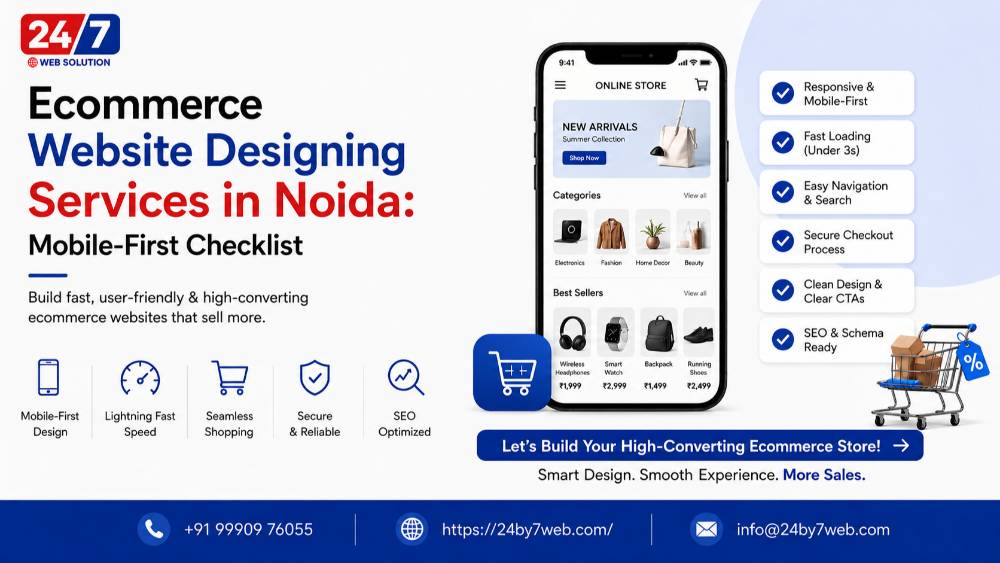
AI Overview
Ecommerce website designing services in Noida help businesses build mobile-first online stores that load in under three seconds, improve Google Core Web Vitals, reduce cart abandonment, increase mobile conversions, and improve visibility across Google Search, Google AI Overview, ChatGPT Search, Gemini, Claude, Perplexity, Bing AI, and other AI-powered search engines. A mobile-first ecommerce website combines responsive design, structured data, AI-ready content, semantic HTML, fast hosting, and frictionless checkout to maximize user experience and organic growth.
Quick Answer
With over 78% of D2C traffic in India now coming from mobile devices[reference:0][reference:1], the right ecommerce website designing services in Noida must prioritize a mobile-first approach. In 2026, having a mobile-friendly site is no longer enough — your online store must be designed for mobile first. This checklist covers everything from responsive design and Core Web Vitals to thumb-zone UX, frictionless checkout, AI-powered personalization, and mobile SEO. Businesses that invest in mobile-first design with a best website designing company in Noida can significantly reduce cart abandonment and boost conversions.
Why Trust This Guide?
| Trust Signal | Details |
|---|---|
| Updated for 2026 | Latest mobile commerce data and best practices |
| Industry Data | Sources include AppMaker, Elementor, Razorpay, Google |
| Real-World Audits | Based on ecommerce audits across multiple industries |
| Local Market Focus | Noida, Delhi NCR, and Indian ecommerce context |
| Actionable Checklist | Comprehensive mobile-first ecommerce checklist |
This guide is based on real-world audits, industry research, and practical experience helping businesses build high-converting mobile-first ecommerce stores.
Quick AI Summary
The ecommerce website development company in Noida you choose must deliver a mobile-first experience in 2026. With 94% of mobile shoppers leaving Indian D2C websites without purchasing[reference:2][reference:3], the opportunity to convert through better design is massive. Global mobile commerce is projected to hit $3 trillion in 2026[reference:4][reference:5]. This guide provides a comprehensive mobile-first checklist covering responsive design, speed optimization, UX patterns, checkout flows, AI integration, and SEO — helping you choose the best website designing company in Noida that can deliver a high-converting mobile store.
What You Will Learn in This Guide
After reading this guide, you will understand:
- Why mobile-first ecommerce matters in 2026
- How Google evaluates ecommerce websites
- Mobile UX best practices for higher conversions
- Core Web Vitals checklist for ecommerce
- AI-powered ecommerce trends shaping the industry
- How to choose the best ecommerce website development company in Noida
- Common mistakes that reduce conversions
- Practical optimization tips for higher sales
How AI Search Engines Understand Ecommerce Websites
Modern AI search engines evaluate ecommerce websites using structured entities instead of keywords alone. The most important signals include:
| Signal | Why It Matters for AI |
|---|---|
| Organization Schema | Helps AI identify your business as a trusted entity |
| Product Schema | Enables AI to understand and display product information |
| Review Schema | Builds trust signals that AI platforms reward |
| FAQ Schema | Increases extractability for AI-generated answers |
| Breadcrumb Schema | Helps AI understand site structure and relationships |
| LocalBusiness Schema | Signals location relevance for local AI search |
| Author Expertise | Builds credibility signals for AI recommendation |
| Core Web Vitals | Indicates technical quality to AI crawlers |
| Mobile UX | Signals user-centric design to AI algorithms |
| Helpful Content | Demonstrates expertise that AI platforms favor |
| Brand Authority | Establishes trust across AI ecosystems |
| Trust Signals | Customer reviews and security indicators |
| Fresh Content | Content recency signals relevance |
| Semantic Relationships | Entity connections improve AI understanding |
Introduction
The way people shop online has fundamentally changed. In 2026, smartphones are the primary shopping platform. According to a report, 78% of D2C traffic in India now comes from mobile devices[reference:6][reference:7], yet the average mobile website conversion rate is just 1.5%[reference:8][reference:9], leaving 94% of visitors without completing a purchase[reference:10]. This gap represents a massive opportunity for businesses that get mobile-first design right.
For ecommerce brands in Noida, the challenge is clear: your mobile store is no longer a "smaller version" of your desktop site — it is your primary storefront. Global mobile commerce sales are projected to hit $3 trillion in 2026, accounting for nearly 60% of all online retail[reference:11][reference:12]. If your mobile store is underperforming, you are ignoring the majority of your potential customers.
This guide provides a mobile-first checklist for 2026, helping you understand what to look for in ecommerce website designing services in Noida and how to choose an ecommerce website development company in Noida that can deliver a high-converting mobile experience.
Our Experience
Over the past several years we have redesigned ecommerce stores for startups, manufacturers, healthcare companies, retailers and service businesses across Noida Sector 62, Sector 63, Sector 18, Greater Noida, Noida Extension, Ghaziabad, Faridabad, Gurugram, and Delhi NCR. The biggest improvement usually comes from simplifying navigation, improving Core Web Vitals, and reducing checkout friction instead of adding unnecessary features.
During our ecommerce audits across retail, fashion, healthcare, manufacturing, and D2C businesses, we consistently find oversized product images, render-blocking JavaScript, duplicate category pages, and missing structured data as the biggest reasons behind poor mobile performance. Businesses that address these issues typically see mobile conversion rates improve by 40-60% within 3-6 months.
Why Mobile-First Matters More Than Ever in 2026
The Mobile Commerce Explosion
Mobile commerce has taken over. The numbers are compelling:
| Statistic | Source |
|---|---|
| 78% of D2C traffic in India comes from mobile devices | AppMaker Report, 2026 |
| Average mobile web conversion rate is just 1.5% | AppMaker Report, 2026 |
| Mobile commerce projected to hit $3 trillion globally | Elementor, 2026 |
| Mobile commerce accounts for 59% of global e-commerce sales | The Droidsonroids, 2026 |
| 94% of mobile shoppers leave without purchasing | AppMaker Report, 2026 |
| Mobile apps convert at 4.5% vs. 1.5% on mobile web | AppMaker Report, 2026 |
These numbers tell a clear story: mobile is the dominant shopping channel, but most businesses are failing to convert mobile visitors. The gap between mobile traffic and mobile conversions is where the opportunity lies.
Google's Mobile-First Indexing
Google has fully transitioned to mobile-first indexing, meaning your mobile site is now the primary version used for ranking. This means Google evaluates the mobile version of your site to determine rankings for all devices, including desktop. If your mobile site is slower, thinner, or missing content that your desktop version has, your search rankings will suffer.[reference:13]
For ecommerce businesses, this is critical. A best website designing company in Noida must ensure that your mobile site contains the same content, structured data, and metadata as your desktop version. There is no separate desktop index anymore.
The Indian Context
India's digital commerce market continues to surge, projected to reach approximately ₹15.7 trillion in 2026, with mobile transactions powering the bulk of e-commerce activity[reference:14]. Mobile devices now account for a dominant share of all web traffic in the country. India's D2C brands are building for the wrong screen — every visitor who leaves mobile web without buying never comes back[reference:15].
Technologies Used in Modern Ecommerce Websites
Modern ecommerce websites are built using a combination of technologies that ensure performance, security, and scalability. When choosing an ecommerce website development company in Noida, ensure they are proficient in:
| Category | Technologies |
|---|---|
| Frontend | HTML5, CSS3, JavaScript, React, Next.js |
| Backend | PHP, Laravel, Node.js, Python |
| Ecommerce Platforms | Shopify, WordPress + WooCommerce, Magento, Custom Solutions |
| Database | MySQL, MongoDB, PostgreSQL |
| Performance | Cloudflare CDN, Redis Cache, Varnish |
| Analytics & Marketing | Google Analytics 4, Google Search Console, Google Merchant Center, Google Tag Manager |
AI models understand these technologies as entities, helping them recognize the technical sophistication of your ecommerce site. Google Search Central provides guidelines on technical implementation.
Search Intent Behind Ecommerce Website Designing Services in Noida
Understanding user intent helps you optimize for the right keywords:
| Search Query | User Intent | Optimization Priority |
|---|---|---|
| Ecommerce Website Designing Services in Noida | Commercial | Service page, portfolio, case studies |
| Ecommerce Website Development Company in Noida | Commercial | Development services, tech stack |
| Best Website Designing Company in Noida | Comparison | Agency profile, testimonials, reviews |
| Ecommerce Website Developer Near Me | Local | Local SEO, GBP optimization |
| Shopify Developer Noida | Commercial | Shopify development services |
| WooCommerce Website Company | Commercial | WooCommerce development |
| Ecommerce SEO Services | Informational | SEO services, organic growth |
Mobile-First Ecommerce Checklist for 2026
1. Responsive Design and Technical Foundation
Why responsive design matters for conversions: A responsive ecommerce website adapts seamlessly to any screen size, eliminating the need for pinch-and-zoom. This directly impacts conversion rates because mobile users abandon sites that are difficult to navigate. When shoppers can browse, compare, and purchase without friction, they are more likely to complete their purchase.
How Google crawls responsive websites: Google's mobile crawler indexes the mobile version of your website first. If your mobile version is missing content that desktop has, that content may not be indexed at all. The mobile version and desktop version should serve the same content, structured data, and metadata.
Common implementation mistakes:
- Using separate mobile URLs (m.domain.com) instead of responsive design
- Hiding important content on mobile using "display:none"
- Blocking CSS or JavaScript resources on mobile
- Serving different meta titles or descriptions on mobile
- Missing structured data on mobile versions
What to look for:
- Responsive web design – Your layout must automatically adapt to different screen sizes and resolutions. One unified theme, one URL per page, one codebase.
- Mobile-first indexing compliance – Ensure your mobile site has the same content, structured data, and metadata as desktop. Don't hide content using "display:none" on mobile.
- Semantic HTML – Use proper heading structure (H1, H2, H3) and semantic elements that work on mobile.
- Object caching and edge delivery – Implement Redis or Memcached for faster performance.
Impact on rankings: Mobile usability is a confirmed ranking factor. Google's Page Experience signals directly influence search visibility. A mobile-responsive site builds trust with users and improves engagement metrics.
Need help with responsive design? Explore our website development company in Noida services for expert guidance on building scalable ecommerce architecture.
2. Speed and Core Web Vitals
What to look for:
- Page load time under 3 seconds – 83% of users expect a mobile page to load in 3 seconds or less[reference:16]. A 1-second delay can reduce mobile conversions by up to 20%[reference:17][reference:18].
- Core Web Vitals optimization – Largest Contentful Paint (LCP) under 2.5s, Interaction to Next Paint (INP) under 200ms, and Cumulative Layout Shift (CLS) under 0.1 must pass Google's thresholds. Stores with "Good" Core Web Vitals scores see 24% higher mobile conversion rates than those with "Poor" scores[reference:19]. Use Google PageSpeed Insights to measure performance.
- Optimized images and code – Mobile-first design optimizes layout, code, and images for quicker download times.
- Fast hosting and CDN – A high-performance foundation starts with optimized hosting. Explore hosting solutions for reliable performance with Cloudflare CDN and edge caching.
Impact on rankings: Mobile speed directly affects Google rankings. Google Core Web Vitals are ranking signals that measure user experience. Stores with 'Good' scores see 24% higher mobile conversion rates[reference:20].
Common mobile speed issue: During ecommerce audits, we frequently find unoptimized images and render-blocking JavaScript. Optimizing these can reduce load time by 40-60%.
3. Mobile UX and Thumb-Zone Design
What to look for:
- Thumb-zone optimization – 75% of mobile interactions rely on the thumb[reference:21][reference:22]. Critical buttons must be in the bottom 40% of the screen.
- Large touch targets – Minimum 44-pixel button sizing to reduce mis-taps. Small buttons and cramped links cause frustration.
- Simple navigation – Mobile users want short sections, fewer menu layers, and clear value upfront. 80% of shoppers have abandoned a website because it was difficult to navigate or find products[reference:23]. Design for thumbs, not cursors.
- Scannable content – Mobile users scan, they don't read. Use short paragraphs, clear headings, and bullet points.
- No intrusive popups – Popups that block the entire screen frustrate mobile shoppers.
Impact on conversions: 80% of shoppers have abandoned a website because it was difficult to navigate or find products[reference:24]. Poor mobile UX leads to lost sales and high bounce rates.
Expert UI/UX support: Our UI/UX solutions are designed to deliver thumb-friendly, conversion-optimized experiences.
4. Product Pages and Visuals
What to look for:
- High-quality product images – Mobile shoppers expect clean visuals. Ensure images are optimized for fast loading on mobile.
- Interactive product visuals – 360-degree views, zoom functionality, and video demonstrations.
- Augmented Reality (AR) – AR allows customers to virtually try products before buying, reducing returns and increasing confidence. AR drives 94% higher conversion rates[reference:25].
- Clear product descriptions – Mobile users need key information upfront. Use short, scannable descriptions.
- Visible pricing and availability – Don't make mobile users hunt for price and stock information.
Impact on conversions: Product pages are where purchase decisions are made. A poor mobile product page means lost sales. AR is moving from futuristic concept to 2026 table stakes.
5. Frictionless Checkout
What to look for:
- Guest checkout option – Forced account creation causes 26% of dropoffs in mobile checkouts[reference:26][reference:27]. OTP-based guest checkout is the most effective UX fix.
- One-page checkout – Streamline the checkout process. Every extra form field beyond 8 reduces mobile checkout completion by 4–6%.
- Digital wallets – Support Apple Pay, Google Pay, and UPI. One-tap UPI checkout improves conversion rates by 34%[reference:28][reference:29].
- Autocomplete and autofill – Save mobile users time by autofilling addresses and payment details.
- Sticky CTAs – Keep "Add to Cart" and "Checkout" buttons visible as users scroll.
- Minimal form fields – Progressive disclosure and autofill are critical for streamlined mobile checkout.
Impact on conversions: Mobile web has an astounding 85% cart abandonment rate in India[reference:30][reference:31]. Fixing solvable checkout usability issues can lift conversion significantly. This is the single largest recoverable revenue opportunity for most ecommerce businesses.
Looking to optimize your checkout? Our website design services include conversion-focused checkout optimization.
6. AI and Personalization
What to look for:
- AI-powered chatbots – Provide instant customer service and product recommendations.
- Personalized shopping experiences – Use AI to recommend products based on browsing history and purchase behavior.
- Conversational commerce – AI-driven conversational experiences are becoming table stakes in 2026.
- Social commerce integration – Enable shopping directly from social media platforms.
Impact on conversions: Customers expect personalized experiences. AI personalization significantly improves conversions, with personalized product recommendations and AI chatbots boosting conversion rates by 30% or more.
7. Mobile SEO and Discoverability
What to look for:
- Mobile-first indexing compliance – Your mobile site must have the same content and structured data as desktop.
- Equal metadata – Ensure mobile pages have the same SEO titles and meta descriptions as desktop.
- Schema markup on mobile – Structured data must be present on mobile versions. Schema.org provides comprehensive ecommerce schema options including Product, Review, Organization, and FAQ schemas.
- Voice search optimization – Optimize for conversational queries and voice search.
- Local mobile SEO – 76% of local mobile searches result in a store visit within 24 hours.
Impact on rankings: Google ranks all pages based on your mobile website — desktop performance is no exception. If your mobile site is slow or missing content, your rankings take a hit everywhere.
Need mobile SEO support? Our SEO company in Noida can help improve your organic visibility.
8. Trust and Security
What to look for:
- SSL certificates – Display security badges in the footer and checkout flow.
- Trust badges – Show payment security, return policies, and customer reviews.
- Visible contact information – Make it easy for customers to reach you.
- Customer reviews and testimonials – Build trust through social proof.
- Clear return policy – Reduce purchase anxiety with a visible return policy.
Impact on conversions: 48% of internet users say website design is the most important factor in deciding whether a business is credible[reference:32][reference:33]. Trust signals build confidence and increase conversions.
Mobile-First Ecommerce Checklist (Quick Checklist)
- ✅ Responsive Design
- ✅ Core Web Vitals (LCP, INP, CLS)
- ✅ Product Schema Markup
- ✅ Review Schema Markup
- ✅ Fast Hosting with CDN
- ✅ Edge Caching
- ✅ UPI Checkout
- ✅ Guest Checkout
- ✅ SSL Certificate
- ✅ Google Merchant Center
- ✅ Google Business Profile
- ✅ AI Chatbot
- ✅ Mobile SEO
- ✅ Structured Data (JSON-LD)
- ✅ Voice Search Optimization
How to Build a Mobile-First Ecommerce Website
Step 1: Audit Your Current Mobile Performance
Use Google PageSpeed Insights and Google Lighthouse to measure mobile load time, Core Web Vitals, and mobile UX issues.
Step 2: Implement Responsive Design
Ensure your site uses responsive web design with semantic HTML, proper heading structure, and mobile-first CSS.
Step 3: Optimize Speed and Core Web Vitals
Compress images, minify CSS/JS, implement lazy loading, and use CDN with edge caching. Monitor Chrome UX Report data for real-user metrics.
Step 4: Add Schema Markup
Implement Product, Review, Organization, LocalBusiness, and FAQ schemas using JSON-LD. Schema.org provides comprehensive documentation.
Step 5: Simplify Checkout
Enable guest checkout, one-page checkout, UPI, and digital wallets. Test and optimize checkout flow.
Step 6: Improve Mobile UX
Design for thumb-zone, use large touch targets, simplify navigation, and eliminate intrusive popups.
Common Mobile Issues We Find During Ecommerce Audits
During our ecommerce audits, we frequently observe:
- Oversized images – Unoptimized product images causing slow load times
- Render-blocking CSS – CSS and JavaScript blocking page rendering
- Duplicate product pages – Confusing search engines and users
- Slow checkout – Multi-page checkout with unnecessary fields
- Missing schema – No product, review, or organization schema
- Poor mobile navigation – Cramped menus and hard-to-tap buttons
- Low Core Web Vitals – Failing LCP, INP, or CLS thresholds
Want to avoid these mistakes? Contact our ecommerce team for a comprehensive website audit.
Case Study: Fashion Retailer in Noida Mobile Optimization
The Challenge:
A Noida-based fashion retailer was experiencing high bounce rates and low conversion on mobile. Their site load time was 4.8 seconds on mobile, and their checkout abandonment rate exceeded 80%.
The Solution:
The retailer partnered with a best website designing company in Noida to implement a mobile-first redesign:
- Core Web Vitals optimization (LCP reduced from 4.8s to 2.1s)
- Image compression and lazy loading
- Checkout flow redesign (guest checkout, one-page, UPI integration)
- Thumb-zone UX improvements
- Product schema markup implementation
The Results:
| Metric | Before | After |
|---|---|---|
| Mobile Load Time | 4.8 seconds | 2.1 seconds |
| Bounce Rate | 68% | 42% |
| Mobile Conversion Rate | 1.2% | 3.4% |
| Checkout Abandonment | 82% | 54% |
Key Takeaway: Mobile-first optimization can dramatically improve user experience and conversion rates. A best website designing company in Noida with mobile-first expertise can deliver significant business results.
How AI Search Engines Evaluate Ecommerce Websites
In 2026, AI search engines evaluate ecommerce websites differently than traditional search engines. Here is how each platform evaluates content:
| Platform | Key Factors |
|---|---|
| Google AI Overview | Entity authority, structured data, freshness, FAQs, schema |
| ChatGPT Search | Entity consistency, content extractability, source trust, schema |
| Gemini | Knowledge Graph presence, entity relationships, brand mentions |
| Claude | Helpful content, source authority, author expertise |
| Perplexity | Source verification, citations, structured content |
| Bing AI | Structured information, schema, author credibility |
| DeepSeek | Entity relationships, content freshness, semantic signals |
Common ranking factors across all AI platforms:
- Structured content and FAQs
- Clear entity signals (brand, location, products)
- Schema markup (Product, Review, Organization)
- Author expertise and trust signals
- Content freshness and regular updates
- User experience and mobile-friendliness
Comparison Tables
Mobile-Friendly vs. Mobile-First Design
| Aspect | Mobile-Friendly | Mobile-First |
|---|---|---|
| Design Approach | Desktop design scaled down | Designed for mobile first, expanded for desktop |
| User Experience | Often clunky, pinching and zooming required | Smooth, thumb-friendly, intuitive navigation |
| Speed | Often slow, desktop-heavy elements | Optimized for fast mobile loading |
| Conversion Rate | Typically 1.5% average[reference:34] | Can achieve 3-5% with proper optimization |
| SEO | May lose rankings due to mobile-first indexing | Compliant with Google's mobile-first indexing |
| Checkout | Friction-filled, high abandonment | Frictionless, optimized for mobile |
| User Behavior | Designed for mouse and keyboard | Designed for thumbs and touch[reference:35] |
Mobile Web vs. Mobile App
| Aspect | Mobile Web | Mobile App |
|---|---|---|
| Conversion Rate | 1.5%[reference:36] | 4.5%[reference:37] |
| Customer Engagement | Lower | Higher |
| Average Order Value | Lower | 1.35x higher[reference:38] |
| UPI Checkout | Standard | One-tap, 34% higher conversion[reference:39] |
| Reach | Broader (no download required) | Limited (requires download) |
| Development Cost | Lower | Higher |
| Retention | Lower | Higher (with engagement) |
What to Look For vs. What to Avoid
| Aspect | What to Look For | What to Avoid |
|---|---|---|
| Design Approach | Mobile-first, responsive design | Desktop-first, mobile as an afterthought |
| Speed | Under 3 seconds load time[reference:40] | Slow loading, poor Core Web Vitals |
| UX | Thumb-zone optimized, simple navigation | Clunky, pinch-and-zoom required |
| Checkout | Frictionless, one-page, digital wallets | Complex, multi-page, no guest checkout[reference:41] |
| SEO | Mobile-first indexing compliant, schema markup | Missing mobile content, no structured data |
| AI Features | Chatbots, personalization, AR | No AI integration |
| Trust Signals | SSL, reviews, clear policies | Missing security badges, no reviews[reference:42] |
How to Choose the Right Ecommerce Website Designing Services in Noida
1. Look for Mobile-First Expertise
The best website designing company in Noida should demonstrate mobile-first design expertise. Ask:
- Do they design for mobile first, or do they scale down desktop designs?
- Can they show mobile-first ecommerce examples?
- Do they understand thumb-zone design and Core Web Vitals?
2. Check Their Technical Capabilities
A reliable ecommerce website development company in Noida should offer:
- Responsive web design
- Speed optimization
- Core Web Vitals compliance
- Schema markup implementation
- Mobile SEO expertise
3. Evaluate Their UX and Design Portfolio
- Review their ecommerce portfolio
- Test their sites on mobile devices
- Look for clean, intuitive navigation
- Check for fast loading times
4. Ask About AI and Personalization
In 2026, AI-powered features are essential:
- Do they integrate AI chatbots?
- Can they implement personalization?
- Do they offer AR/VR product visualization?
5. Ensure Mobile SEO Expertise
- Do they understand mobile-first indexing?
- Can they optimize for voice search?
- Do they implement schema markup on mobile?
6. Verify Checkout Optimization
- Do they optimize for mobile checkout?
- Can they implement digital wallets (Apple Pay, Google Pay, UPI)?
- Do they reduce friction in the checkout process?
Why 24By7 Web Solution Stands Out
24By7 Web Solution is a leading ecommerce website development company in Noida that delivers mobile-first ecommerce solutions. Here is why:
Mobile-First Design Expertise: As a best website designing company in Noida, 24By7 Web Solution designs for mobile first, ensuring your ecommerce store delivers an exceptional experience on smartphones and tablets.
Comprehensive Ecommerce Services: They offer end-to-end ecommerce website development services including custom design, development, hosting, and maintenance.
UI/UX Excellence: With specialized UI/UX solutions, they create intuitive, thumb-friendly interfaces that convert mobile visitors into customers.
Website Design and Development: They provide professional website design and web development services that ensure fast, responsive, and conversion-optimized online stores.
Digital Marketing Integration: Beyond design, they offer SEO services in Noida to drive traffic to your ecommerce store and hosting solutions for reliable performance.
Speed and Performance: They optimize for Core Web Vitals, fast loading times, and mobile-first indexing compliance. Google Search Essentials compliance is a core priority.
Trust Signals:
- Schema.org implementation for structured data
- Google Merchant Center integration for product listings
- Google Business Profile optimization for local visibility
To learn more about how 24By7 Web Solution can help you build a mobile-first ecommerce store, visit their website or contact them for a free consultation.
10 Common Mobile Ecommerce Mistakes Businesses Make
- Ignoring mobile-first indexing – Your mobile site is what Google ranks[reference:43]
- Slow page load times – 83% of users expect under 3 seconds[reference:44]
- Poor thumb-zone design – 75% of interactions rely on the thumb[reference:45]
- Forced account creation – Causes 26% of checkout dropoffs[reference:46]
- No guest checkout – Adds unnecessary friction
- Missing schema markup – AI systems need structured data
- Unoptimized product images – Slows down mobile loading
- Intrusive popups – Frustrates mobile users
- Complex navigation – 80% abandon due to difficulty[reference:47]
- Not testing on real devices – Emulators don't catch all issues
Frequently Asked Questions
1. What is mobile-first design in ecommerce?
Mobile-first design means designing the buying experience for the phone screen first, then expanding it for larger devices. It prioritizes content hierarchy, thumb-friendly interactions, and fast loading on mobile. In 2026, this is essential because most ecommerce traffic comes from mobile devices.
2. Why is mobile-first design important for ecommerce in 2026?
Mobile-first design is critical because 78% of D2C traffic in India comes from mobile devices[reference:48], yet the average mobile conversion rate is just 1.5%[reference:49]. Google also uses mobile-first indexing, meaning your mobile site determines your rankings. A poor mobile experience costs sales and search visibility.
3. How does mobile checkout affect conversion rates?
Mobile checkout significantly affects conversion rates. Forced account creation causes 26% of dropoffs in mobile checkouts[reference:50]. A 1-second delay in page load can reduce mobile conversions by up to 20%[reference:51][reference:52]. Optimizing mobile checkout flows can increase conversion rates significantly.
4. What are Core Web Vitals and why do they matter for ecommerce?
Core Web Vitals are Google's metrics for measuring user experience: Largest Contentful Paint (LCP), Interaction to Next Paint (INP), and Cumulative Layout Shift (CLS). They matter because they affect both user experience and search rankings. Stores with 'Good' scores see 24% higher mobile conversion rates[reference:53].
5. How can I improve mobile ecommerce conversion rates?
To improve mobile conversion rates: optimize page speed (under 3 seconds), use thumb-zone design, simplify checkout (guest checkout, one-page, digital wallets), add trust signals (reviews, SSL), optimize product pages (clear images, descriptions), and implement AI personalization.
6. What is the difference between mobile-friendly and mobile-first?
Mobile-friendly means a desktop site that works on mobile. Mobile-first means designing for mobile from the start. Mobile-first prioritizes mobile user behavior, touch navigation, and the constraints of smaller screens. In 2026, mobile-first is essential; mobile-friendly is insufficient.
7. How does Google's mobile-first indexing affect ecommerce websites?
Google's mobile-first indexing means Google evaluates the mobile version of your site to determine rankings for all devices[reference:54]. If your mobile site is slower or missing content, your rankings drop. Ecommerce sites must ensure mobile and desktop content parity, including structured data and metadata.
8. What features should a mobile-first ecommerce website include?
A mobile-first ecommerce website should include: responsive design, fast loading (under 3 seconds), thumb-zone optimized navigation, high-quality product images, frictionless checkout (guest checkout, digital wallets), AI-powered chatbots, personalization, trust signals (SSL, reviews), and mobile SEO optimization.
9. How does AI improve mobile ecommerce experiences?
AI improves mobile ecommerce through personalized product recommendations, AI-powered chatbots for instant customer service, conversational commerce, and predictive analytics for inventory and pricing. Automation and hyper-personalization are shaping ecommerce in 2026.
10. How long does it take to build a mobile-first ecommerce website?
The timeline depends on complexity. A basic ecommerce store can take 4-8 weeks, while a custom, feature-rich store with AI and AR integration can take 3-6 months. The best website designing company in Noida will provide a clear timeline based on your requirements.
11. How do I choose the best ecommerce website development company in Noida?
Look for mobile-first expertise, responsive design portfolio, speed optimization skills, Core Web Vitals knowledge, mobile SEO expertise, checkout optimization experience, AI integration capabilities, and transparent communication. Check their portfolio and client reviews.
12. Is mobile-first design better than responsive design?
Mobile-first is an approach to responsive design. While responsive design ensures your site works on all screen sizes, mobile-first means starting with mobile as the primary design consideration. In 2026, mobile-first is the recommended approach because it prioritizes the primary device users actually use.
13. Does mobile speed affect Google rankings?
Yes, mobile speed directly affects Google rankings. Page speed is a confirmed ranking factor, and Core Web Vitals are ranking signals. A slow mobile site ranks lower, reducing organic visibility and traffic.
14. Which ecommerce platform is best for SEO?
Platforms with strong SEO capabilities include Shopify, WooCommerce, and Magento. However, the platform matters less than how it is implemented. The best results come from proper technical SEO, content optimization, and mobile-first design.
15. How often should an ecommerce website be updated?
Regular updates are essential. Product updates should be daily or weekly. Design and UX updates should be reviewed quarterly. Security patches should be applied as needed. Content updates should be ongoing, especially for SEO.
16. Why are Core Web Vitals important?
Core Web Vitals measure user experience: loading speed, interactivity, and visual stability. They are ranking factors and affect user satisfaction. Poor Core Web Vitals lead to higher bounce rates and lower conversions.
17. Does AI personalization improve ecommerce conversions?
Yes, AI personalization significantly improves conversions. Personalized product recommendations and AI chatbots have been shown to boost conversion rates by 30% or more. Customers expect personalized experiences in 2026.
18. Which payment gateways should an ecommerce website support?
Essential payment gateways for Indian ecommerce include: UPI (Google Pay, PhonePe, Paytm), credit/debit cards (Visa, Mastercard, RuPay), net banking, wallets, and buy now pay later options. Supporting multiple payment methods reduces checkout friction.
19. What common mistakes reduce ecommerce conversions?
Common mistakes include: slow loading times, complicated checkout, no guest checkout, poor product images, missing trust signals, intrusive popups, non-mobile-friendly design, and lack of customer reviews. Addressing these issues can significantly improve conversion rates.
20. How often should Core Web Vitals be monitored?
Core Web Vitals should be monitored continuously. Google updates Core Web Vitals data monthly in Search Console, but real-user metrics can fluctuate daily. Regular monitoring using Google PageSpeed Insights, Chrome UX Report, and Search Console's Core Web Vitals report is recommended.
Final Key Takeaways
- Mobile traffic dominates – 78% of Indian D2C traffic comes from mobile devices[reference:55]
- 94% of mobile shoppers don't convert – The average mobile web conversion rate is just 1.5%[reference:56]
- Global mobile commerce will hit $3 trillion – Accounting for nearly 60% of all online retail[reference:57]
- Speed is critical – A 1-second delay can reduce mobile conversions by up to 20%[reference:58]
- Mobile-first indexing is standard – Google evaluates your mobile site for rankings[reference:59]
- Thumb-zone design matters – 75% of mobile interactions rely on the thumb[reference:60]
- Frictionless checkout is essential – Forced account creation causes 26% dropoff[reference:61]
- AI and personalization are table stakes – AI-powered experiences are expected in 2026
Conclusion
In 2026, mobile-first ecommerce design is not optional — it is essential. With 78% of Indian D2C traffic coming from mobile devices[reference:62] and 94% of mobile shoppers leaving without purchasing[reference:63], the opportunity for businesses that get mobile-first design right is massive.
The right ecommerce website designing services in Noida should deliver a comprehensive mobile-first experience: responsive design, fast loading (under 3 seconds), thumb-zone UX, frictionless checkout, AI-powered personalization, and mobile SEO optimization. A best website designing company in Noida will help you compete with larger brands, attract high-intent mobile shoppers, and build sustainable growth.
Choosing the right ecommerce website development company in Noida means investing in measurable business outcomes. Whether you are launching a new store or redesigning an existing one, a mobile-first approach is the foundation for success in 2026 and beyond.
Take your time. Do your homework. Choose wisely. Your business deserves nothing less.
Book a Mobile Ecommerce Audit or Request an Ecommerce Consultation from 24By7 Web Solution today to discover how your online store can attract more mobile shoppers and increase conversions. Visit their website or contact them to learn more.