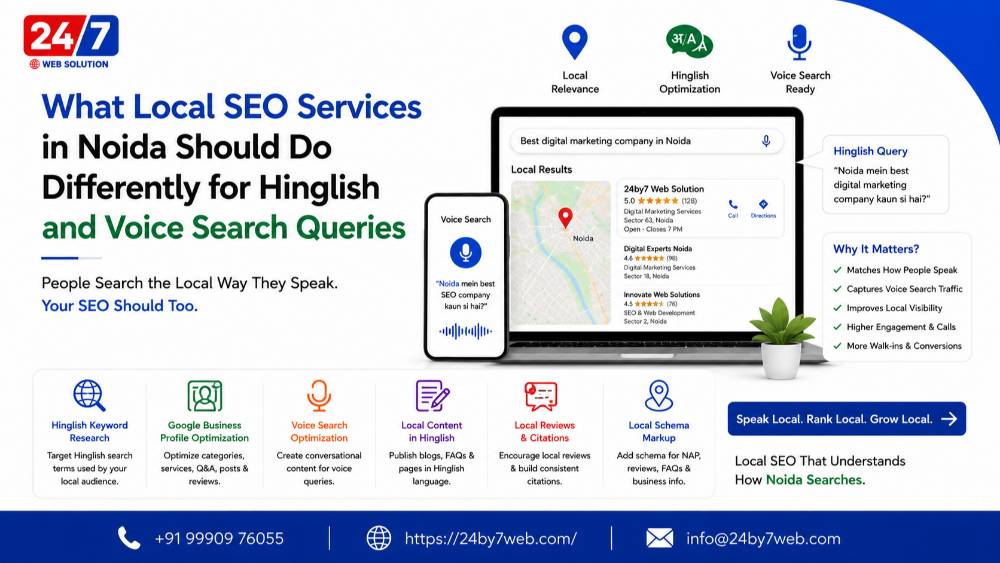
Quick Answer: Local SEO services in Noida that work on conversational search focus on how real customers actually speak, not just the way they type. For businesses whose customers use Hinglish, this can include researching conversational Hinglish query patterns like "Noida mein best salon kaunsa hai" alongside English keywords, building FAQ sections with natural phrasing, keeping Google Business Profile information complete and consistent, and using structured data where it accurately describes the page. These practices can support clearer local-search visibility across Google Search and Maps, and may also improve how business information is understood across conversational and AI-powered search experiences.
Here is how conversational search differs from traditional typed search:
| Dimension | Typed Search | Conversational or Voice Search |
|---|---|---|
| Query length | Often shorter keyword phrases | Often longer, natural-language questions |
| Query structure | Fragmented keywords: "salon Noida" | Full question: "Noida mein best salon kaunsa hai jo Sunday open ho" |
| Intent | Mixed informational and navigational | Frequently local and question-based |
| Primary device | Desktop and mobile | Mobile, smart speaker, car |
| Result format | List of links | Single spoken answer or AI summary |
| Language | Often English or mixed-language keywords | May include Hinglish, Hindi or other regional-language phrasing |
If you run a business in Noida, some customers may now use longer, more conversational queries, particularly on mobile and voice-enabled interfaces. They pick up their phone, tap the microphone, and ask a full question in the language they are most comfortable with. That language is often Hinglish, a natural mix of Hindi and English that reflects how people actually talk.
A customer might say: "Noida mein sabse acchi SEO agency kaunsi hai?" or "Mere paas sabse acha dentist kahan milega?" These queries are closer to natural questions than traditional keyword phrases. And many conventional local SEO strategies do not account for them.
This guide explains what local SEO services in Noida should focus on to reach this segment of local search traffic. It focuses on the practical changes a local SEO strategy can make when customers use longer, conversational, and mixed-language queries.
Why Voice Search Matters for Local Businesses
Voice and conversational search have become important considerations for local businesses in India, particularly as users increasingly search through natural-language queries and mobile interfaces. For Noida businesses, this makes conversational query research useful alongside conventional keyword research.
Not every voice search is local. People use voice for weather, calculations, general knowledge, navigation, and entertainment. But a meaningful share of voice activity is directed at local services: finding a salon, checking a restaurant's hours, or asking for a plumber nearby. That is where local SEO becomes relevant.
YouGov research found that 62% of consumers in India had issued voice commands on their phone as of June 2022. The study used an urban-representative sample for India, meaning the findings reflect urban consumer behaviour rather than the entire population. India also led in using voice commands on laptops and desktops at 29% in the same survey. Voice is not a fringe behaviour. It is part of how people search.
The Hinglish Factor
Hinglish is a commonly used mixed-language communication style in India and can be relevant to search-query research. Standard keyword tools often cannot see these patterns. According to research on India's code-mixed queries, romanised, code-mixed searches account for a substantial share of Indian mobile queries, concentrated in consumer, how-to, finance-adjacent and price-sensitive intents.
In many Hinglish queries, English terms are used for products, categories and technical concepts, while Hindi words often frame the question, such as "kaise," "konsa," "ke liye," or "sasta." The same research shows that English carries the entities and category terms, while Hindi carries the question frames and intent markers, which makes the layer researchable despite the tools' blindness.
This means a business selling "AC repair service" should also consider queries like "AC service near me sasta" or "AC thik karne wala kaun hai." A business offering home loans should think about phrasings like "home loan ke liye documents kya chahiye."
Google can interpret mixed-language and conversational queries, but using the language your audience naturally understands can make the content clearer and more useful for those users.
What Local SEO Services in Noida Should Do Differently
A local SEO strategy for Noida can incorporate Hinglish and voice search as part of the broader approach. Here is what that looks like in practice.
1. Map Conversational Hinglish Queries
Standard keyword research often misses Hinglish patterns because romanised Hindi has no standard spelling and the combinations are long-tail by nature. Local SEO providers who work with conversational queries build their query lists differently.
They mine Search Console data for Hinglish patterns: queries containing "kaise," "kahan," "kya," "mere paas," "ke liye," and "sasta." They analyse on-site search logs. And they test representative conversational queries using the voice-search interface available on the devices and services their customers use.
The goal is not to stuff Hinglish phrases into content. It is to understand the natural register of your customers and create content that answers their questions the way they ask them.
2. Build FAQ Sections with Natural Language
FAQ sections with question-and-answer pairs in natural language can be a useful format for covering specific question-based searches with concise answers.
Well-structured FAQs often look like this:
- H3 heading: "Noida mein best salon kaunsa hai?" or "Which salon in Noida is best for bridal makeup?"
- Direct answer in a concise paragraph: "For bridal makeup in Noida, a good starting point is to compare salons with recent bridal portfolios, transparent packages, and trial options. Many salons in Sector 18 offer personalised packages with trial sessions."
- Supporting details below
This format can be useful for users, AI-generated answers, and search features. However, structured data does not guarantee inclusion in AI Overviews, voice answers, or featured snippets. The content itself still needs to be genuinely helpful.
3. Keep Google Business Profile Complete and Consistent
A complete and accurate Google Business Profile is an important local-search foundation, particularly for business information such as location, hours, categories, and services. However, voice and AI systems can use multiple sources, and the exact sources vary by query and platform.
Google explains that Business Profile information is assembled from multiple sources, including the official website, public information, third-party data, and user contributions. This is why consistency matters. Keep your core business information consistent across your website, Google Business Profile and reputable third-party listings.
Google's local ranking guidance confirms that local results are primarily based on relevance, distance, and popularity. The term "popularity" reflects how well known and trusted a business is online and in the community.
Adding useful, up-to-date photos and videos when relevant also helps customers understand the business. Responding to reviews consistently and professionally supports the overall profile.
4. Use Structured Data Where It Accurately Describes the Page
Structured data helps search engines extract precise information. LocalBusiness schema tells Google exactly what the business is, where it operates, and what services it offers. FAQ structured data can describe FAQ content to search engines.
Google has stated that structured data is not required for AI Overviews or AI Mode, and there is no special schema markup that a business must add for these features. Structured data can still be useful where it accurately describes the page and supports existing search features, but it should not be treated as a shortcut to AI visibility.
It is worth noting that Google removed FAQ rich results from normal Search in 2026. As of May 7, 2026, FAQ rich results stopped appearing in Google Search. Google's own documentation confirms the change. FAQ content is still valuable for users and for answer coverage, but structured data should be treated as a way to describe the page accurately rather than as a shortcut to a rich result.
Speakable structured data exists as a beta feature for identifying content suitable for text-to-speech, but it should not be presented as a general ranking mechanism for local voice search. Google's documentation describes it primarily around specific use cases rather than as a universal voice-search tool.
5. Write in the Way People Speak
Marketing language that sounds polished on a screen often sounds unnatural when spoken. A conversational local SEO approach writes for both contexts.
Instead of "We provide comprehensive dental care solutions," a conversational version might say "We offer root canal treatment, teeth cleaning, and braces in Noida Sector 62." The second version is how a customer would describe the service to a friend, and it is closer to how they would ask for it using voice search.
This conversational approach extends to meta descriptions, page titles, and heading structure. Use wording that remains clear when a user hears the answer rather than reads it.
A Comparison: Conventional Local SEO vs. Conversational Search Strategy
| Element | Conventional Local SEO | Conversational Search Strategy |
|---|---|---|
| Keyword strategy | Location plus service keywords | Location, service, and natural-language queries |
| Content | Search-intent-focused pages | Search-intent pages plus concise answers |
| Google Business Profile | Complete and accurate profile | Same, with customer-focused information kept current |
| Structured data | Relevant schema where supported | Relevant schema where it accurately describes the page |
| Query research | Keyword tools and Search Console | Keyword data plus conversational-query analysis |
| Content tone | Clear and informative | Clear, natural, and easy to understand when spoken |
How Different AI Search Platforms Behave
AI search platforms do not necessarily use the same retrieval systems, sources, or ranking signals. A page appearing in Google Search does not guarantee that it will be cited by ChatGPT, Gemini, Perplexity, or Microsoft Copilot. For that reason, AI visibility should be monitored separately across the platforms that matter to the business.
For ChatGPT and other AI search systems, test natural-language prompts that reflect real customer questions and record whether your business is mentioned, whether your website is cited, which page is cited, and whether the business information is accurate. Repeat the same prompt set over time because AI-generated responses can change.
Google says AI Overviews and AI Mode use the same foundational SEO principles as regular Search, while the specific sources and links shown can vary by query and AI system. There are no additional technical requirements specifically required for inclusion in these AI features beyond being indexed and eligible for normal Search.
For Microsoft Copilot and supported Bing AI experiences, Bing Webmaster Tools now provides AI Performance data such as cited pages, citation counts, and grounding queries. These metrics describe citation activity rather than conventional rankings. Bing itself states that AI Performance metrics show citation activity, not rankings, authority, or importance, and that the data is aggregated and sampled. It should be used for trend analysis rather than as a complete record of every AI answer.
This means AI visibility should be treated as a separate observation point rather than a conventional ranking position. A citation, mention, or spoken result does not automatically represent a ranking or traffic gain.
Practical Steps for Noida Businesses
Even if you are managing local SEO in-house, you can apply the core principles that conversational-search strategies use.
Step 1: Mine Your Search Console Data
Open Google Search Console and filter your queries for Hinglish patterns: "kaise," "kahan," "kya," "mere paas," "ke liye," "sasta," "kitna," and "kaunsa." You will likely find queries you never targeted but that real customers are using.
These queries provide first-party insight into how your customers describe their needs. Your own Search Console data can reveal query patterns that generic keyword tools may not expose.
An increase in question-based and conversational queries can be a useful indicator that your content is reaching users with more natural-language search intent. However, Search Console does not by itself identify which queries came specifically from voice input.
Step 2: Build a Hinglish FAQ Layer
For each service page, add an FAQ section with three to five questions. Write one version in English and one in natural Hinglish. Do not translate word-for-word. Instead, write the Hinglish version the way a customer would actually say it.
Example for a tutoring centre:
- English: "Do you offer home tuition in Noida?"
- Hinglish: "Noida mein ghar par tuition mil sakti hai kya?"
Both versions serve different query patterns and expand your coverage across text and conversational search.
Step 3: Complete Every GBP Field
Go to your Google Business Profile and fill in every relevant section. Add all services. Choose the most specific categories. Set accurate hours, including holiday hours. Add useful photos and videos when relevant. Respond to reviews consistently and professionally.
Keeping the profile accurate should be one of the first local SEO tasks to address. Google confirms that complete and accurate Business Profile information helps Google understand the business and can support local search visibility.
Step 4: Add LocalBusiness and FAQ Structured Data
If you are using WordPress, SEO plugins for WordPress can simplify this implementation. If your site is custom-built, ask your developer to implement LocalBusiness structured data on appropriate pages and use FAQ structured data only where it accurately represents the visible FAQ content.
The team at 24By7 Web Solution can help with this if you need support.
Step 5: Test Conversational Search Visibility
Test representative conversational queries using the voice-search interface available on the devices and services your customers use. See which businesses appear. If you are not in the answer, you have a clear starting point for improvement.
Do this test periodically. Conversational search results change as platforms update their models and as competitors adjust their local information.
Conversational Query Starter List for Noida Businesses
Here are common Hinglish query patterns by industry. Use these as starting points, then mine your own data for the specific phrasings your customers use.
| Industry | Common Hinglish Query Patterns |
|---|---|
| Healthcare | "Noida mein best doctor kaun hai," "paas mein clinic kahan hai," "dentist near me sasta" |
| Real Estate | "Noida mein 2BHK kitne ka hai," "flat ke liye loan kaise milega," "sector 150 mein property" |
| Education | "Noida mein best coaching kaunsi hai," "BCA admission kaise hoga," "ghar par tuition chahiye" |
| Home Services | "AC repair wala kahan milega," "plumber near me," "ghar ki safai ke liye service" |
| Beauty and Wellness | "Noida mein best salon kaunsa hai," "bridal makeup kitne ka hai," "spa near me" |
| Food and Dining | "Noida mein best restaurant kaun sa hai," "home delivery kahan se karu," "cafe near me" |
How to Measure Whether Your Local SEO Is Working for Conversational Search
Conversational search visibility is harder to measure consistently than conventional organic rankings because the interface may return a single spoken response rather than a conventional results page. Manual testing and related local-search signals can provide directional evidence, but they should not be treated as a direct ranking metric.
Search Console Query Mining
Look for increases in long-tail, question-based queries. This can indicate that your content is reaching users with more natural-language search intent. Search Console alone does not distinguish voice queries from typed queries, so treat this as an indicator rather than proof.
Google Business Profile Insights
Track calls, direction requests, website clicks, and bookings from your Business Profile. Changes in these actions can help assess local-search performance, but they should not be attributed to voice search alone.
Direct Conversational Testing
Run periodic tests using the voice and conversational interfaces your customers use. Record which businesses appear for your target queries. Over time, you can see whether your improvements are moving you into the answer.
AI Overview and Featured Snippet Appearances
Featured snippets and AI-generated answers are separate search features, but concise question-and-answer content can be useful across multiple search experiences. Track each surface separately rather than assuming visibility in one guarantees visibility in another.
Google Search Console's Generative AI performance report now shows impressions for AI Overviews and AI Mode, giving you a direct view of AI visibility in Google's ecosystem.
Why This Matters for Choosing a Local SEO Partner
Providers differ in how much they incorporate Hinglish and conversational search into their local SEO strategies. Some strategies may focus primarily on conventional English keyword research, while others may also analyse conversational query patterns.
When you evaluate a local SEO provider, ask how they handle Hinglish queries. Ask whether they keep Google Business Profile information complete and consistent. Ask whether they include FAQ content and relevant structured data in their strategy. A provider of SEO services in Noida should be able to explain how its strategy addresses these aspects of the local search landscape.
If you want a partner who works this way, the team at 24By7 Web Solution helps Noida businesses adapt their local SEO for conversational and Hinglish queries.
Frequently Asked Questions
1. What are Hinglish queries, and why do they matter for local SEO?
Hinglish queries are search phrases that mix Hindi and English, typically written in Latin script. Examples include "Noida mein best salon kaunsa hai" or "AC service near me sasta." They matter because Hinglish is commonly used in everyday communication and can appear in conversational searches, while conventional English keyword research may not capture every variation.
2. How is voice search different from typed search for local businesses?
Voice queries are often longer, more conversational, and frequently local. They are phrased as full questions rather than keyword fragments. Voice assistants may return a single spoken answer rather than a list of links. This means clear local information and easily understandable content can help a business become more relevant to location-based questions.
3. What is the most important step for local search visibility?
Keeping Google Business Profile information complete, accurate, and consistent with your website and reputable third-party listings is an important foundational step. After that, build FAQ sections with direct, conversational answers and implement relevant structured data on appropriate pages.
4. How do I find the Hinglish queries my customers are using?
Mine your Google Search Console data. Filter for queries containing Hindi question words like "kaise," "kahan," "kya," "kaunsa," "kitna," and "sasta." Also check your on-site search logs. These patterns are specific to your business and cannot always be found in external keyword tools.
5. Should I write my entire website in Hinglish?
No. English remains important for a large segment of your audience. The goal is to add Hinglish layers to key pages, especially FAQ sections and service descriptions. Use Hinglish where it fits naturally. Think of it as adding a conversational layer on top of your existing content, not replacing it.
6. How long does it take to see results from conversational search optimisation?
Results vary by business, query, and platform. Google Business Profile changes may influence local visibility over time. Content and structured data changes may take longer to influence conversational and AI answers. Track indirect signals like Business Profile calls, direction requests, and long-tail query growth over several months.
7. Do I need to hire an agency for this, or can I do it myself?
You can implement the core steps yourself if you have the time. The most technical part is structured data, which may require developer support. If you want a local SEO provider in Noida to handle the full process, look for one that can explain its Hinglish and conversational search approach clearly.
8. How does conversational search relate to AI Overviews and ChatGPT?
Voice assistants and AI search systems can both process natural-language queries, but they use different products, retrieval systems, and ranking or citation processes. Improving visibility in one does not guarantee visibility in another. Track each platform separately.
9. What structured data should I use for local search?
LocalBusiness structured data can help search engines understand important business information when it accurately describes the page. FAQ structured data can be used where the page genuinely contains FAQ content. Speakable schema (currently in beta) marks specific passages as suitable for text-to-speech playback, but its documented use cases are specific. Start with LocalBusiness and FAQ where relevant, then explore Speakable only if it fits your content type.
10. Will Hinglish SEO work for businesses outside Noida?
The exact language mix varies by region, audience, and business category, so businesses outside Noida should use their own Search Console and customer data to identify local phrasing. Hinglish queries are common across North India, but the specific patterns depend on your customers.
About 24By7 Web Solution
This guide was prepared by the team at 24By7 Web Solution, a digital marketing and SEO services provider based in Noida. We help local businesses optimise for conversational search, Hinglish queries, and AI-powered discovery. For questions about your own local SEO strategy, you can contact us or learn more about our team.