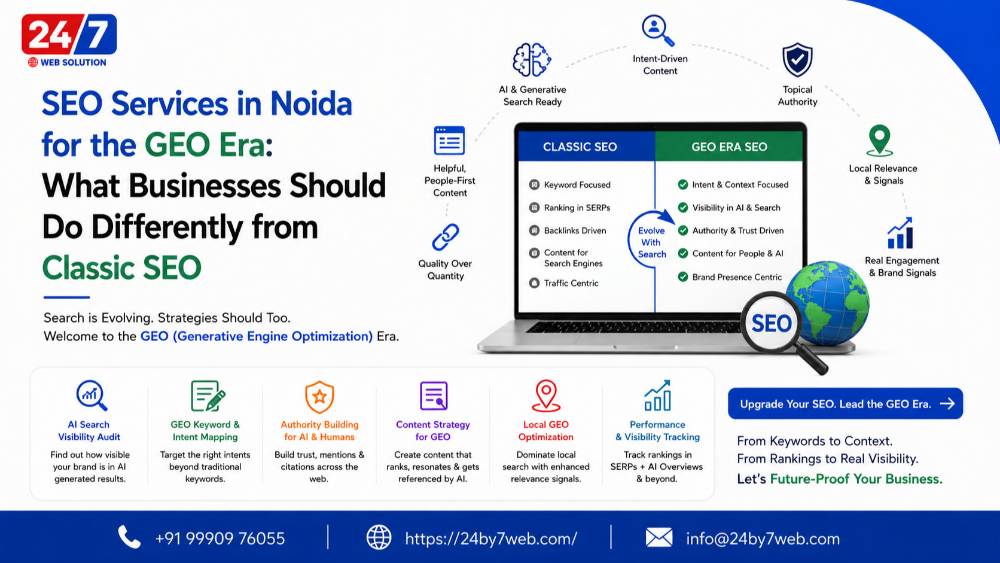
Quick Answer: GEO (Generative Engine Optimization) refers to practices intended to improve a brand's visibility and citations in generative AI search experiences. It complements traditional SEO rather than replacing it. While classic SEO optimises for rankings and clicks on a search results page, GEO focuses additional attention on how content appears in AI-generated answers from systems like ChatGPT, Perplexity, Gemini, and Google AI Overviews.
Here is the core difference in one table:
| Dimension | Traditional SEO | GEO / AI-Search Optimization |
| Primary goal | Earn organic visibility and clicks | Improve visibility and citation in AI-generated answers |
| Success metrics | Rankings, organic clicks, sessions, conversions | AI visibility, citations, AI referrals, and conversions where measurable |
| Main surfaces | Search results pages | AI Overviews, AI Mode, and generative AI assistants |
| Content focus | Helpful, comprehensive pages | Helpful content with clear, extractable answers where appropriate |
| Important considerations | Technical SEO, relevance, quality, links, page experience | The same SEO foundations, plus clarity, entity context, freshness, and AI visibility measurement |
For years, the formula for visibility in Noida was straightforward. You researched keywords, built quality backlinks, optimised page speed, and climbed the rankings. That formula still matters. But it is no longer the complete picture.
AI assistants have changed how some users research products and services before visiting a website. They type questions into ChatGPT, check Perplexity for comparisons, and read Google's AI Overviews before they ever click a link. If your business is not represented in relevant AI answers, you may be missing one source of discovery for people who use those experiences.
This guide explains what GEO means, how it relates to the SEO you already know, and what businesses in Noida should do differently. It also covers the questions worth asking a SEO Company in Noida as you adapt your strategy.
What GEO Actually Means
Generative Engine Optimization is a term used to describe efforts to improve a brand's visibility in generative AI search experiences. The goal is to make your content easier for AI systems to find, understand, and potentially cite as a source when generating answers to user questions.
In classic SEO, you optimise a page to rank for a keyword. The user sees your link on a search results page, clicks it, and lands on your website. The click is the goal. Rankings and traffic are the primary metrics.
In the AI-search environment, the dynamic shifts. A user asks a question. The AI synthesises information from multiple sources and presents a consolidated response. Your brand might be cited as a source. Or it might not be mentioned at all. The goal expands from earning a click to also earning visibility and citation.
Generative AI experiences can synthesize information from multiple sources rather than presenting only a conventional list of links. Their retrieval and citation behavior varies by platform and query. This means there is no single universal formula that works identically across ChatGPT, Gemini, Perplexity, Google AI Overviews, and Bing.
Similarweb data indicates that generative AI platforms drew roughly 9.5 billion monthly visits worldwide in May 2026, up around 70% year over year. The same dataset suggests that most ChatGPT users also use Google, indicating these systems are layering on top of traditional search rather than replacing it entirely.
Why Classic SEO Alone Is Not the Whole Picture
Classic SEO still works. It remains the foundation. Google's official guidance on optimizing for generative AI features confirms that SEO best practices remain relevant because generative AI features are rooted in core Search ranking and quality systems. But there are limits that become more obvious in an AI-first environment.
The Click Is No Longer Guaranteed
Even when your page ranks well, AI Overviews can answer the query directly at the top of the results page. A page that ranks well in Google can still not be cited by a particular AI system for a particular query, because AI systems use different retrieval and citation processes.
AI Systems Can Work With Passages
Traditional SEO optimised whole pages for a target keyword. AI systems can retrieve relevant passages from a page, so clear headings and self-contained explanations can make important information easier to understand and evaluate. Google's guidance notes that there is no requirement to break content into tiny pieces. Its systems can understand the nuance of multiple topics on a page. However, clear structure can still improve usability and help readers find what they need.
The Signals Overlap but Are Not Identical
Backlinks and keyword relevance still carry weight. For AI-search visibility, it is useful to consider semantic context, entity clarity, source credibility, content freshness, and how easily important information can be understood. A page can rank well in Google and still be overlooked by an AI system if its structure or clarity makes extraction difficult.
AI Citations Can Change More Quickly
Traditional rankings can persist for months or years. AI citation patterns can change as search systems, queries, source availability, and published information change. Some industry analyses have reported that relatively recent sources appear frequently in AI answers, though citation behavior varies by platform and query. This means content that is not updated regularly may gradually lose citation share to newer sources.
What Businesses in Noida Should Do Differently
The core principles of good SEO — authoritative content, technical health, topical depth — still apply. What changes is how you structure, present, and maintain that content for AI systems.
1. Make Important Answers Easy to Find
In classic SEO, a warm-up paragraph before the main answer was often acceptable. In the AI-search environment, placing a direct, standalone answer near the top of a section helps both users and AI systems.
Lead with a clear answer to the primary question in each section. Keep it concise. Use descriptive headings that match how people search. Do not require context from surrounding sections for the answer to make sense.
This does not mean abandoning good writing. It means placing the most useful version of your answer where it can be easily found.
2. Use Clear, Self-Contained Sections
AI systems can retrieve relevant passages from a page, so each section benefits from standing on its own where possible. Use clear sections for readers rather than fragmenting a page into artificial one-question blocks solely for AI systems.
This means:
- Use descriptive headings, including question-based headings where they match user intent.
- Keep paragraphs short, ideally two to four sentences.
- Use tables for comparisons and numbered lists for step-by-step processes.
- Add FAQ sections when they genuinely help users answer common questions.
3. Build Entity Clarity, Not Just Keyword Coverage
Traditional SEO often focused on covering a keyword thoroughly. Clear business information helps search and AI systems understand what an organization does, where it operates, and what topics its website covers.
This means:
- Maintain consistent business information across your website, Google Business Profile, and third-party directories.
- Build a clear About page that establishes your expertise and location.
- Use author bylines and credentials where relevant.
- Prioritize legitimate business profiles, relevant directories, industry publications, partnerships, and other contexts where the business information is genuinely useful.
Topical depth and clear entity context can complement traditional keyword relevance and help both users and search systems understand what a business covers.
4. Add Verifiable Claims and Credible Sources
Concrete data, clearly attributed claims, and credible sources can make content more useful and easier to evaluate. When you make a claim, support it with a number, a date, or a source.
A 2024 KDD research paper, GEO: Generative Engine Optimization, reported visibility improvements of up to 40% in its experimental evaluation, although results varied by domain and optimization strategy. This research suggests that including statistics, citations, and credible references can improve how content performs in AI-generated answers.
5. Keep Important Content Current
There is no universal refresh schedule for AI visibility. Review content when statistics, products, services, regulations, platform behavior, or other important facts change.
Build a content review cycle into your SEO services in Noida strategy. Update statistics, add new examples, and revise sections that have become outdated. Keep publication and update dates accurate and visible where appropriate. Use supported Article structured data to help search engines understand those dates, but do not treat dateModified as a guarantee of AI visibility.
6. Optimise for Local AI Queries
When someone asks an AI assistant for a service "near me" in Noida, local signals can influence how businesses are represented. A July 2026 Search Engine Journal analysis, citing Whitespark research, reported AI Overviews appearing in 68% of sampled local searches. Accurate business information, Google Business Profile data, reviews, and local references can contribute to how businesses appear in local search and AI-generated recommendations.
If you are working with a local SEO services in Noida provider, ask how they are managing these local signals for AI visibility, not just for Maps rankings.
The Noida GEO Readiness Checklist
For local businesses preparing for AI search, this practical checklist brings the core tasks into one view.
| Area | What to Check |
| Technical SEO | Site is crawlable, indexed, fast on mobile |
| Content clarity | Direct answers to common commercial questions |
| Entity consistency | Business name, address, services match across the web |
| Local signals | Google Business Profile, reviews, and directory listings updated |
| Authority references | Credible sources cited where claims are made |
| Freshness | Key statistics and dates reviewed regularly |
| AI visibility tracking | Google Search Console, Bing Webmaster Tools, and GA4 configured |
| Conversion path | AI-referred visitors have a clear next step |
Work through each row once per quarter. It is a simple way to keep both traditional SEO and AI-search visibility moving together.
How GEO and AEO Relate
The terms AEO and GEO are used inconsistently across the industry, and there is no single universally accepted distinction. A practical working model is to use AEO for answer-focused content optimization and GEO for the broader effort to improve visibility across generative AI experiences.
AEO (Answer Engine Optimization) focuses on making content answerable. It is about structuring pages so AI systems can find and extract clean answers to specific questions.
GEO (Generative Engine Optimization) is broader. It includes the structural work of AEO, but also covers entity clarity, brand consistency across the web, content freshness, and the strategic decisions around how your brand appears in AI-generated answers.
In practice, most businesses benefit from both. AEO handles the mechanics of extractable content. GEO handles the broader visibility layer that helps AI systems recognise your brand as a source.
Google's guidance on optimizing for generative AI features confirms that SEO best practices remain the foundation, and that valuable, unique, people-first content is the strongest signal for visibility across traditional and AI-powered search.
What to Ask Your SEO Company in Noida About GEO
If you are evaluating SEO services in Noida, here are the questions that help separate agencies with a genuine GEO approach from those still selling the 2020 playbook.
Questions Worth Asking
| Question | What a Useful Answer Sounds Like |
| How do you structure content for AI visibility? | Clear headings, answer-first sections, tables, and FAQ blocks where relevant |
| How do you measure AI visibility? | AI referral traffic in analytics, Google Search Console's Generative AI performance report for AI Overview and AI Mode impressions, and Bing Webmaster Tools' AI Performance data for citations and cited pages |
| What is your content refresh cycle? | Content reviewed when key facts, statistics, or platform behavior change |
| How do you build entity clarity? | Consistent business information, Google Business Profile management, author credentials, About page optimisation |
| How do you handle local AI queries? | Local signals, reviews, accurate business data, location-specific content |
An SEO Company in Noida should be able to explain its GEO methodology in plain language and show how it connects to measurable business outcomes, not just rankings.
Need to check how your current website looks in AI search? Review your SEO, local SEO, and AI-search visibility with the team at 24By7 Web Solution.
The Bottom Line
Classic SEO taught us to optimise for rankings and clicks. GEO adds a focus on visibility and credibility in AI-generated answers. Both matter. For most businesses, treating conventional SEO and AI-search visibility as complementary is more practical than treating them as competing strategies.
For businesses in Noida, the shift is practical. Make important answers easy to find. Use clear, self-contained sections. Build entity clarity. Cite verifiable claims. Keep important content current. Manage local signals. And ask your SEO partner the right questions about how they measure AI visibility.
The fundamentals of good SEO still apply. But the surface has changed, and understanding how AI search works can help your business stay visible across both traditional and AI-powered platforms.
Frequently Asked Questions
1. What is GEO, and how is it different from SEO?
GEO stands for Generative Engine Optimization. It is a term commonly used for practices intended to improve a brand's visibility and citation in generative AI search experiences. Classic SEO optimises for rankings and clicks on a search results page. GEO focuses additional attention on how content appears in AI-generated answers.
2. Do I still need classic SEO if I focus on GEO?
Yes. Classic SEO remains the foundation. Technical health, authoritative content, topical depth, and backlinks still matter. Google itself confirms that SEO best practices remain relevant for AI-powered search experiences. GEO extends these fundamentals by adding clarity, entity context, and content freshness signals.
3. How do I know if my content is being cited by AI systems?
There is no single tool that shows every AI citation. You can track AI referral traffic in GA4, use Google Search Console's Generative AI performance report to monitor impressions from AI Overviews and AI Mode, and check Bing Webmaster Tools' AI Performance dashboard for citation data. Combining these sources gives you a directional picture.
4. What type of content works best for AI visibility?
Answer-first content with direct, standalone answers, descriptive headings, tables, numbered lists, FAQ sections, and verifiable statistics can work well. Content with clear, self-contained explanations can be easier for users and automated systems to interpret.
5. How often should I refresh content for AI visibility?
There is no universal refresh schedule for AI visibility. Review content when statistics, products, services, regulations, platform behavior, or other important facts change. This keeps key facts accurate and avoids outdated claims on high-value pages.
6. Does local SEO still matter for AI search?
Yes. Local signals like accurate business information, Google Business Profile data, reviews, and local references can influence how businesses are represented in location-based AI queries. If you serve customers in Noida, managing these signals remains important.
7. Can a small business in Noida compete for AI citations?
Yes. Business size alone does not determine whether a site can be cited; relevance, quality, accessibility, source selection, and query context can all affect which sources appear. Smaller businesses can appear in AI-generated answers when their content is useful, accessible, and relevant to a particular query.
8. What should I ask my SEO Company in Noida about GEO?
Ask how they structure content for AI visibility, how they measure AI visibility, how they handle content freshness, how they build entity clarity, and how they manage local AI queries. If they cannot explain their methodology, ask for examples and reporting samples.
9. Is GEO a replacement for AEO?
No. AEO focuses on making content answerable. GEO is broader and includes entity clarity, brand consistency, freshness, and strategic visibility building. Most businesses benefit from both.
10. How long before I see results from GEO?
There is no reliable universal timeframe for GEO results. A page may be surfaced relatively quickly for some queries, while establishing consistent visibility across multiple AI platforms can take longer. Track changes over time rather than treating a fixed number of weeks as a guarantee.
About 24By7 Web Solution
This guide was prepared by the team at 24By7 Web Solution, a digital marketing and SEO services provider based in Noida. For questions about your own GEO strategy, you can contact us or learn more about our team.